

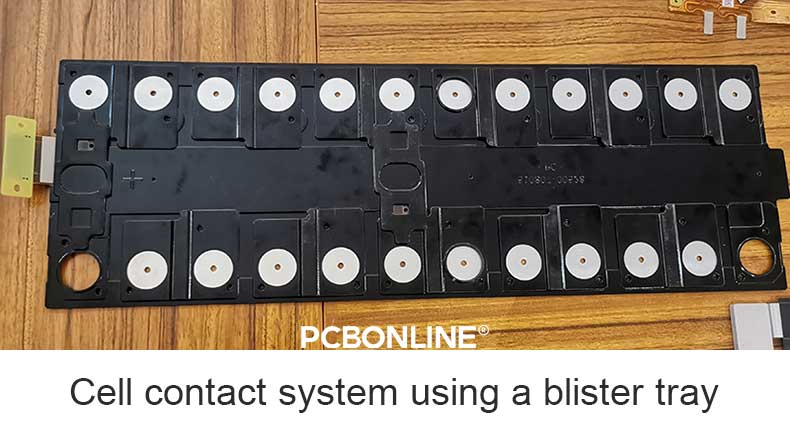
In electric vehicle (EV) technology, the Battery Management System (BMS) and the Cell Contact System (CCS) play a critical role in ensuring the battery pack's long-term reliability and passenger safety.
PCBONLINE provides one-stop CCS manufacturing and assembly. Our article explores the integral role of NTC (Negative Temperature Coefficient) thermistors within the CCS, their design principles, and a detailed look at the leading thermistor models used in the automotive industry today.
In this article:
Part 1: Understanding the CCS Part 2: The Role of NTC Thermistors in CCS Safety Part 3: Leading NTC Thermistor Models for CCS Applications Part 5: One-Stop CCS Manufacturer PCBONLINE1. Understanding the CCS
The Cell Contact System (CCS) is the integrated module that connects individual battery cells into a cohesive power unit. A CCS is a flexible circuit assembly consisting of:
- Busbars: Usually laser-welded copper or nickel plates that handle the high-current electrical connections.
- FPC (Flexible Printed Circuit) or FFC (Flat Flexible Cable): The signal circuit layer that collects voltage and temperature data.
- Insulation components: Plastic trays, heat-resistant films, or injection-molded carriers that provide structural support and electrical isolation.
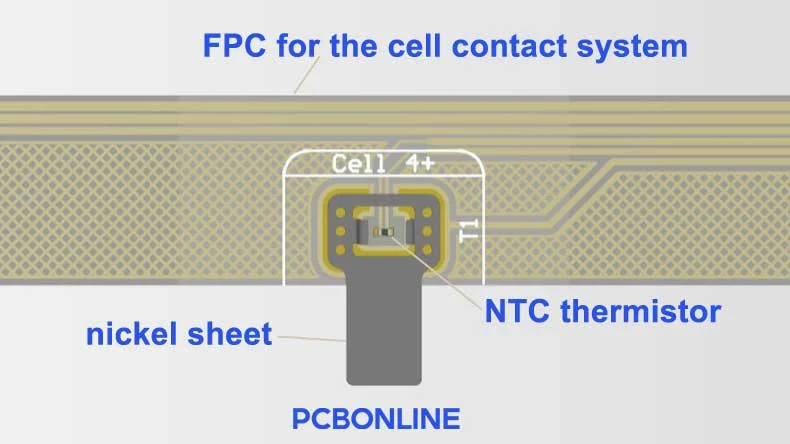
In the FPC or FFC designs, the electronic components on a CCS are kept to a minimum to reduce weight and complexity. Only two types of electronics are present: Connectors (to bridge the data to the BMS) and NTC Thermistors.
2. The Role of NTC Thermistors in CCS Safety
NTC thermistors are resistors whose resistance decreases significantly as temperature rises. In a battery pack's cell contact system, they serve as the primary "thermal sensors."
Precision thermal monitoring
Battery cells have an optimal "comfort zone." Operating outside this range leads to reduced lifespan, and in extreme cases, thermal runaway.
NTCs are strategically placed on the busbars or cell shoulders to capture the most accurate temperature data.
Redundancy and the "back-up" principle
Safety design for CCS follows a Redundancy Principle (often called the "Replacement" or "Back-up" principle).
If one temperature sensor fails, nearby sensors are positioned to provide overlapping data, ensuring the BMS never loses sight of the module's thermal state.
Heat simulation and placement
The number and placement of NTCs are not random. Engineers use thermal simulation and experimental testing to identify the highest and lowest temperature points within a module.
The sensors are then placed at these critical junctions to monitor the maximum temperature difference, which is a key indicator of battery health.
Leading NTC Thermistor Models for CCS
Based on industry standards and the technical specifications of major NTC thermistor manufacturers like Shiheng Electronics and Thinking Electronic, here are six commonly used NTC models for CCS integration.
① MF51 Series: high heat resistance glass-encapsulated NTC
The MF51 is a single-ended, glass-sealed radial thermistor designed for high-sensitivity and high-heat environments.

- Key features: Small size, rapid response, and excellent axial glass packaging.
- Operating temperature: -40°C to +250°C (some variations up to +300°C).
- Application: Ideal for CCS designs requiring high durability and protection against moisture and harsh chemical environments.
② MF52B Series: enameled wire lead NTC

The MF52B is a precision temperature-measuring thermistor characterized by its enameled wire leads.
- Key features: The use of 0.28mm enameled wire allows for a very flexible and thin profile, which is perfect for tight spaces between cells.
- Precision: Available with resistance tolerances as tight as ±1%.
- Application: Widely used in FPC-based CCS where the sensor needs to be low-profile and easily routed through narrow channels.
③ MF72 Series: power NTC thermistor

While primarily known for inrush current limiting, the MF72 series is frequently used in power management sections of the battery system.
- Key features: High power handling capability and a robust silicone coating.
- Stability: Designed to handle significant steady-state currents while maintaining stable resistance characteristics.
- Application: Often found in the charging interface or the power distribution unit (PDU) adjacent to the CCS to prevent surge damage.
④ MF73T Series: high-power surge suppression

The MF73T is the "big brother" to the MF72, designed for high-power battery chargers and EVs.
- Key features: Large body diameter (up to 40mm) and extremely high steady-state current capacity.
- Reliability: Long lifespan and high reliability under heavy electrical loads.
- Application: Specifically used in high-power battery chargers and EV charging equipment to provide surge protection.
⑤ TSM-C Series (Thinking Electronic): automotive grade SMD NTC

The TSM-C series is an AEC-Q200 qualified surface-mount device (SMD), making it the gold standard for automotive reliability.
- Key features: Surface mount packaging (0402, 0603, 0805 sizes) that is compatible with automated SMT assembly on FPCs.
- Temperature range: -50°C to +150°C, showing high stability in high-humidity/high-temperature conditions.
- Application: The primary choice for "patch-style" CCS modules where NTCs are soldered directly onto the flexible circuit.
⑥ Glass-encapsulated SMD NTC (Shiheng MF51 variation)

Often referred to in CCS designs as the "glass-sealed patch," this is a hybrid that combines the robustness of glass sealing with the convenience of SMT.
- Key features: These sensors are often heat-riveted or glued directly to the cell shoulder or nickel collector plates.
- Efficiency: Nickel plates can collect both voltage and heat, and the glass seal ensures the sensor isn't corroded by electrolyte vapors.
- Application: Frequently used in "Line Harness" CCS solutions where NTCs are crimped to nickel tabs and then welded to the aluminum busbars.
One-Stop CCS Manufacturer PCBONLINE
PCBONLINE provides one-stop cell contact system manufacturing, including research and development. We have complete equipment specialized for CCS manufacturing and testing. Our experienced engineers can also design the CCS and solve technical issues.

If you haven't completed your battery pack design, including the BMS and the CCS, you can let us design for you. You can draw the outline of the battery pack and tell us the line connection sequence of the cells and CCS; if possible, send the 3D drawing of the entire pack so that we can understand your CCS and BMS demands.
We take care of CCS manufacturing traceability and print a QR code on the FPC/PCB/integrated busbar PCBA that contains all the information on the manufacturing operations, time, and specs.
Quality is paramount. We focus on weight control to ensure the consistency of all the FPC/PCB/integrated busbars, nickel sheets, NTCs, connectors, insulation films, copper busbars, and blister tray/plastic bracket.
All the inspections during the FPC/PCB/integrated busbar assembly for the CCS are 3D, including SPI, AOI, and X-ray. The high-accuracy images and dimensions are retained for 15 years for traceability.
We not only provide one-stop manufacturing for the CCS but also can design the CCS and BMS according to your battery pack demands.
We have strong manufacturing capabilities and technical experience in new energy automotive and energy storage electronics, especially thermal and electric management.
We provide one-on-one engineering support and can send a CCS sample to you for free if you plan for bulky production. Please get in touch with us by email at info@pcbonline.com if you have any CCS demands.
Conclusion
The integration of NTC thermistors into the Cell Contact System is the foundation of EV battery safety. Whether it is the MF52B's thin enameled wires for space-saving or the TSM-C's automotive-grade surface mounting for high-volume production, choosing the right NTC is critical. If you want to develop your products using a cell contact system, please get in touch with PCBONLINE.
Battery Management System Manufacturing at PCBONLINE.pdf
CCS Product Introduction - PCBONLINE.pdf


