

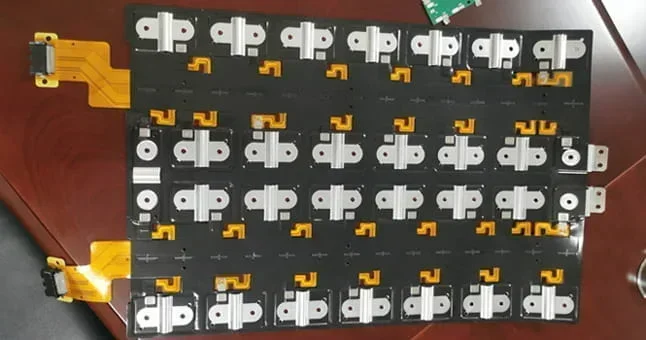
In the New Energy industry, the safety and efficiency of the battery pack are critical. At the heart of the battery pack lies the Cell Contact System (CCS), responsible for electrical connection, voltage monitoring, and temperature sensing of the battery cells.
While the welding of busbars and the design of FPCs (Flexible Printed Circuits) are important, a process ensures the longevity and reliability of the CCS module: Adhesive Dispensing.
PCBONLINE is a one-stop CCS manufacturer providing flexible PCB manufacturing and assembly, CCS module design, CCS manufacturing, and welding. Our guide explores the critical role of adhesive dispensing in CCS manufacturing, the technical requirements for different battery components, and the advanced equipment used to achieve automotive-grade precision.
In this article:
Part 1: The Critical Role of Adhesive Dispensing in CCS Part 2: Application Areas for Dispensing in CCS Part 3: Types of Adhesives Used in CCS Manufacturing Part 4: Technical Challenges and Innovations in Dispensing Part 5: Technical Challenges and Innovations in Dispensing Part 6: Advanced Equipment: How PCBONLINE Ensures Precision1. The Critical Role of Adhesive Dispensing in CCS
The CCS module is an electronic assembly of flexible circuits (FPC), aluminum/copper busbars, plastic brackets, and electronic components, including sensitive NTC thermistors and power connectors.
In the harsh environment of constant vibrations, thermal cycling, and potential exposure to moisture, mechanical fasteners often fall short. That's why adhesive dispensing is necessary.

Adhesive dispensing serves four primary functions in a CCS module:
- Structural bonding & positioning: Securing lightweight components like insulation films and FPCs to rigid busbars or plastic carriers to prevent shifting during assembly or vehicle operation.
- Electrical insulation: Covering exposed conductive surfaces and solder joints to prevent short circuits.
- Environmental protection: Sealing sensitive components against humidity, dust, and electrolyte vapors (waterproofing and corrosion resistance).
- Vibration damping: Absorbing mechanical stress to protect fragile solder joints and thin-film circuits from fatigue failure.
2. Application Areas for Dispensing in CCS
According to the technical standards of leading manufacturers like PCBONLINE, adhesive dispensing is not a "one-size-fits-all" process. Different parts of the CCS require specific adhesive types and dispensing patterns.

A. Connector Protection (Reinforcement and Sealing)
The connector is the gateway for data between the CCS and the Battery Management System (BMS). Since FPCs are inherently soft and flexible, the interface between the rigid connector and the flexible circuit is a major stress point.
Process: Dispensing UV-curable or epoxy resin around the connector pins and the base.
Purpose: To prevent pin damage and ensure that the "Gold Finger" or SMT connector remains securely attached despite the vibration of the battery pack. In some designs, a "Dam and Fill" method is used to create a protective barrier.
B. NTC Thermistor & FUSE Protection
Temperature sensors (NTCs) are crucial for thermal safety. These are often delicate components soldered or crimped onto the CCS.
Adhesive used: High-performance UV adhesives (like VS-UV0281-1) or specialized epoxies.
Function: These adhesives provide a protective shell that is transparent (for inspection) but hard enough to resist physical impact. They also offer moisture resistance, ensuring the sensor's accuracy isn't compromised by environmental factors.
C. Nickel Plate & Busbar Solder Joint Protection
The connection between the battery cells and the CCS is usually made via laser welding or resistance welding of nickel tabs.
Process: Applying a layer of protective coating over the weld spots.
Function: Preventing oxidation and corrosion of the weld joints. It also provides secondary insulation between adjacent busbars to prevent arcing in high-voltage systems.
D. Insulation Film & Gasket Bonding
The CCS module uses various insulation films (like PET or PI) to separate high-voltage components from the module frame.
Process: Precision bead or dot dispensing on the edges of the film or the plastic bracket.
Requirement: The adhesive must have high thermal stability to withstand the heat generated during cell charging and discharging.
3. Types of Adhesives Used in CCS Manufacturing

Choosing the right chemistry is vital for automotive safety compliance (IATF 16949). Based on technical data from the adhesive manufacturer VS-BOND, the following materials are industry standards.
UV Curable Adhesives (Acrylics):
Examples: VS-UV0281-1 (for NTCs), VS-8209-1 (for nickel plates).
Pros: Extremely fast curing (seconds) under 395nm LED UV light, allowing for high-speed production lines.
Epoxy Resins:
Example: VS-3812 series.
Pros: High mechanical strength and chemical resistance. Often used for SMT connectors that require "daming" to prevent glue overflow.
Silicones:
Pros: Excellent flexibility and thermal range. Used when the CCS needs to account for significant thermal expansion and contraction.
Polyurethanes (PU):
Pros: Good balance of cost and performance for large-scale structural bonding of the CCS tray.
4. Technical Challenges and Innovations in Dispensing

Dispensing on a CCS is challenging due to the complex 3D topography of the module and the soft nature of the FPC. Common "pain points" include:
- Bubble formation: Trapped air in the glue can lead to insulation failure. Advanced equipment now uses vacuum degasification and precision jetting valves to eliminate bubbles.
- Overflow (glue creep): If the glue spreads too far, it might cover the busbar welding areas, causing defective welds. This requires high-consistency valves with "Snuff-back" features to ensure a clean cut-off.
- Height variations: Because FPCs can warp slightly, the dispensing height must be adjusted in real-time.
5. Advanced Equipment: How PCBONLINE Ensures Precision
To achieve zero-defect manufacturing, PCBONLINE uses advanced automated dispensing machines for our specialized CCS manufacturing. The equipment integrates seamlessly with the SMT and assembly processes.

A. High-precision jetting valves
Traditional contact needles are being replaced by non-contact jetting valves. These valves can "shoot" adhesive into tight gaps at high speeds without touching the sensitive FPC, preventing mechanical damage.
B. CCD visual positioning & height detection
Modern dispensing machines (like those from Xinhua Intelligent) are equipped with high-resolution cameras and laser height sensors.
- Visual alignment: The system identifies fiducial marks on the FPC to correct for any offset in the module's position.
- Z-Axis compensation: Laser sensors measure the actual height of the component surface, ensuring the gap between the nozzle and the workpiece remains constant, which is critical for volume consistency.
C. Multi-valve asynchronous systems
For large CCS modules used in commercial vehicles or energy storage systems (ESS), single-head dispensers are too slow. Advanced lines use dual-valve or multi-valve systems where the second valve can automatically adjust its pitch (X/Y/Z direction) to dispense on two modules simultaneously, doubling throughput.
6. Dispensing Process for a Turnkey CCS Project
When PCBONLINE handles a turnkey CCS project, the dispensing workflow follows a rigorous quality gate:
Plasma surface treatment: Before dispensing, the FPC and nickel plates undergo plasma cleaning to increase surface energy, ensuring the adhesive bonds perfectly.
Automated dispensing: The machine applies NTC protection, connector reinforcement, and weld-joint sealing in one continuous program.
In-line UV curing: The module passes through a high-intensity UV LED tunnel for instantaneous curing.
AOI (automated optical inspection): A 3D AOI system checks the glue volume, path, and height. Any module with insufficient glue or overflow is flagged immediately.
One-Stop CCS Manufacturer PCBONLINE
PCBONLINE provides one-stop cell contact system manufacturing, including research and development. We have complete equipment specialized for CCS manufacturing and testing. Our experienced engineers can also design the CCS and solve technical issues.
If you haven't completed your battery pack design, including the BMS and the CCS, you can let us design for you. You can draw the outline of the battery pack and tell us the line connection sequence of the cells and CCS; if possible, send the 3D drawing of the entire pack so that we can understand your CCS and BMS demands.
We take care of CCS manufacturing traceability and print a QR code on the FPC/PCB/integrated busbar PCBA that contains all the information on the manufacturing operations, time, and specs.
Quality is paramount. We focus on weight control to ensure the consistency of all the FPC/PCB/integrated busbars, nickel sheets, NTCs, connectors, insulation films, copper busbars, and blister tray/plastic bracket.
All the inspections during the FPC/PCB/integrated busbar assembly for the CCS are 3D, including SPI, AOI, and X-ray. The high-accuracy images and dimensions are retained for 15 years for traceability.
We not only provide one-stop manufacturing for the CCS but also can design the CCS and BMS according to your battery pack demands.
We have strong manufacturing capabilities and technical experience in new energy automotive and energy storage electronics, especially thermal and electric management.
We provide one-on-one engineering support and can send a CCS sample to you for free if you plan for bulky production. Please get in touch with us by email at info@pcbonline.com if you have any CCS demands.
Conclusion
For engineers and procurement professionals, partnering with a manufacturer like PCBONLINE that understands the synergy between FPC fabrication, SMT assembly, and precision dispensing is essential. If you want to develop your products using a cell contact system, please get in touch with PCBONLINE.
Battery Management System Manufacturing at PCBONLINE.pdf
CCS Product Introduction - PCBONLINE.pdf


