

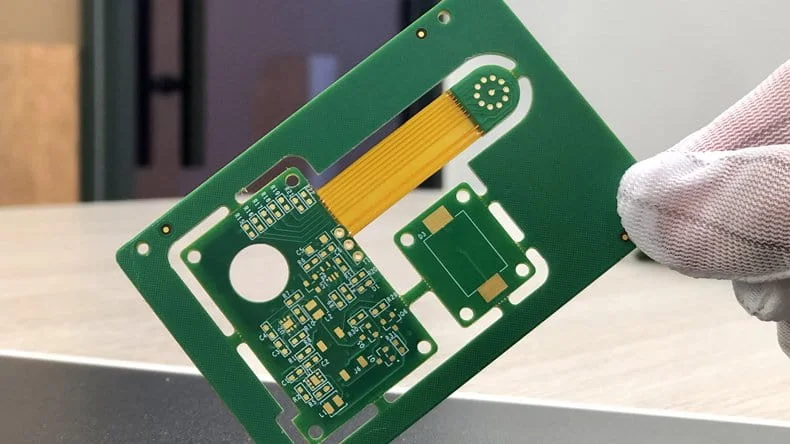
A set of PCBs for automotive and medical inductive probes manufactured by PCBONLINE
Rigid-flex PCBs are a high-end type of printed circuit boards used for compact devices or modules in automotive, medical, IoT wearable, and computing electronics. Automotive and medical are critical industries evolving with human life and requiring long-term stability, so their PCBs, including rigid-flex PCBs, must apply four-terminal sensing and follow IPC Class 3 standards. PCBONLINE fabricates and assembles rigid-flex PCBs for automotive, medical, aerospace, and computing. Explore our rigid-flex PCBs for automotive and medical electronics in this article.
In this article:
Part 1. What Are Rigid-Flex PCBs for Automotive and Medical Electronics? Part 2. Applications of Rigid-flex PCB for Automotive and Medical Electronics Part 3. Rigid-Flex PCBs for Automotive and Medical Must Apply Four-Terminal Sensing and Follow IPC Class 3 Part 4. Partner with PCBONLINE for Rigid-flex PCB Manufacturing for Automotive and MedicalWhat Are Rigid-Flex PCBs for Automotive and Medical Electronics?
Many articles, including the AI tools that conclude from these sources, say a rigid-flex PCB is a combination of rigid and flexible PCBs, with rigid sections and flexible sections at some point. However, this explanation may cause some people to misunderstand that the FR4 rigid sections connect the flexible PCB sections.
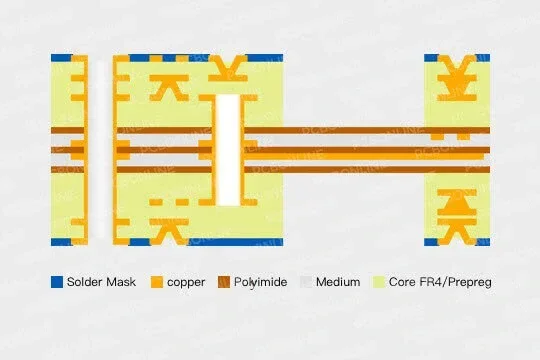
In fact, a rigid-flex PCB is a flexible PCB on the inside, which uses PI (polyimide) as the substrate, insulation, and coverlay materials, RA (rolled annealed) copper as the circuit layers, and epoxy adhesive layers to bond the PI and RA copper.
In a rigid-flex PCB, the flexible PCB is the core, and the FR4 layers are laminated on the flexible PCB, with the unwanted FR4 areas removed by laser to expose the inner PI flexible PCB.
As other flexible PCBs that use RA copper with adhesive for better flexibility, rigid-flex PCBs are used for dynamic uses with frequency bending, rather than those using ED (electro-deposited) copper without adhesive for static uses.
From the advanced PCB manufacturer and assembler PCBONLINE, part of our rigid-flex PCB manufacturing specifications are:
|
Rigid-flex PCB features
|
Capability at PCBONLINE
|
|
Flexible circuit layer
|
1 to 6
|
|
Rigi-flex PCB layer
|
2 to 64
|
|
Flex layers on the outer or middle
|
Middle
|
|
Finished PCB thickness
|
0.2mm to 4.0mm
|
|
Tolerance of PCB thickness
|
>1.0mm, ±10%
≤1.0mm, ±0.1mm |
|
Adhesive flex PCB
|
SF305: PI=0.5mil, 1mil, 2mil; Cu=0.33oz, 0.5OZ, 1OZ
R-F777: PI=1mil, 2mil, 3mil, 4mil; Cu=0.5oz, 1oz |
|
Low-flow prepreg (PP)
|
VT-47N, VT-901LF, EM-37B
|
|
standard FR4
|
IT-180A, S1141, S1000-2, TU-768 (TU-752)
|
|
High-performance FR4
|
Arlon 85N, Rogers RO4350B series, Ventec VT-901, M6 series, R-5775, TUC TU-872SLK, TU-862HF
|
|
Impedance tolerance
|
Single-ended: ±3Ω (≤50Ω), ±8% (>50Ω)
Differential pair: ±4Ω (≤50Ω), ±8% (>50Ω) |
|
HDI type
|
3+n+3 (n buried hole≤0.4mm)
|
|
Min. twist & warp
|
0.75% (symmetrical)
1.5% (asymmetrical)l |
|
Min. distance between R-F connect area to conductors
|
0.3mm (half-depth slot process)
0.5mm normal |
|
Min. distance between E-test pads
|
4mil
|
|
Max. flex circuit thickness
|
3oz
|
|
Min. distance between flex layer conductor and outline
|
10mil
|
Automotive, medical, aerospace, and defense are the four critical fields that require high-performance, high-precision, and high-reliability PCBs.
Rigid-flex PCBs are used for all these sectors, and automotive and medical electronics more commonly use rigid-flex PCBs.
Rigid-flex PCBs for automotive and medical electronics can be used for many systems and modules in the following section.
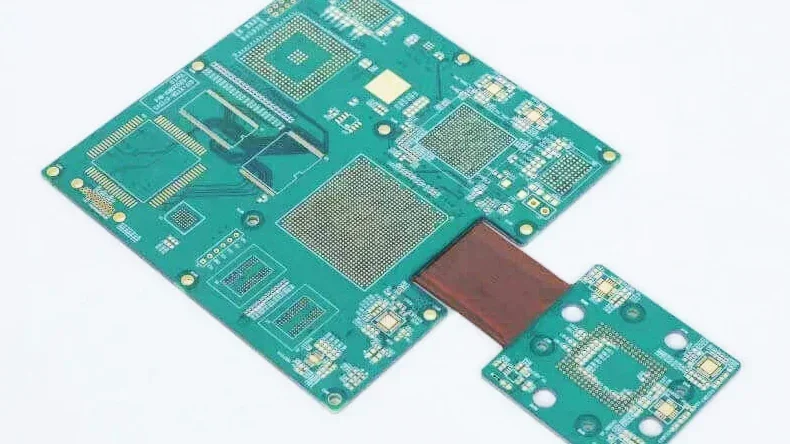
Applications of Rigid-flex PCB for Automotive and Medical Electronics
Rigid-flex PCBs offer enhanced reliability, vibration resistance, and reduced size and weight for both automotive and medical sectors.
Applications of rigid-flex PCBs for automotive include sensor systems, control units, display systems, and LED lighting systems.
In RADAS/autonomous driving sensors, rigid-flex PCBs are used to connect the rigid processing circuitry (DSP, FPGA) with the flexible array of sensor components, such as antennas and laser emitters/receivers, mounted behind the vehicle's fascia.
Rigid-flex PCBs reduce 3D packaging and weight by allowing the sensor to fit into complex, constrained spaces within bumpers and pillars.
Rigid-flex PCBs also eliminate inter-board connectors, providing a more robust connection for mission-critical sensing.
In engine/powertrain control units, rigid-flex PCBs are used for internal wiring and connections between the rigid processing board and various peripheral sensors, such as pressure, temperature, and flow sensors.
Rigid-flex PCBs can survive engine bay temperatures and constant vibration better than wires and connectors.
In infotainment and display systems, rigid-flex PCBs are used to connect complex curved dashboard displays and steering wheel control buttons to the main electronic control unit. Rigid-flex PCBs enable non-planar display configurations and complex cable routing in tight cabin spaces.
In LED lighting systems, rigid-flex PCBs are used in high-power LED headlight and taillight arrays where thermal management and a high number of connections are needed. They provide reliable electrical connections in high-temperature lighting modules.
Applications of rigid-flex PCBs for medical include induction probes, implantable devices, wearable monitoring devices, and portable imaging.
Rigid-flex PCBs are used in induction probes/diagnostic tools, like ultrasound probes and endoscopes. The rigid-flex PCB connects the transducer array to the main rigid processing board in the handle.
It fits complex circuitry into a small space for minimally invasive procedures. Besides, short flexible interconnects minimize signal loss from the sensors.
In implantable devices, such as pacemakers, neurostimulators, and cochlear implants, rigid-flex PCBs are used to connect the internal battery and processor to the electrodes that interface with body tissue.
Rigid-flexible PCBs can be bent to conform to body contours, and the connector-less design ensures long-term reliability inside the human body.
In wearable monitoring devices, such as ECG/EEG monitors and patch sensors, rigid-flex PCBs are used to bend and move with the human body while maintaining continuous connectivity to a rigid battery and processor.

The rigid-flex PCB allows the device to be thin, light, and comfortable, improving patient compliance for long-term monitoring.
In portable medical imaging, such as handheld analyzers and scanners, rigid-flex PCBs interconnect multiple sensor arrays, processing units, and the user interface screen.
The rigid-flex PCB reduces the device's weight and size, making powerful diagnostic equipment portable and ergonomic for field use.
Rigid-Flex PCBs for Automotive and Medical Must Apply Four-Terminal Sensing and Follow IPC Class 3
Four-terminal sensing, also known as the 4-wire method or Kelvin sensing, is an electrical measurement test to obtain highly accurate resistance values in the micro-ohm to milli-ohm range. It measures low resistance without error from test leads or contact resistance. Automotive, medical, aerospace, and military PCBs all require four-terminal sensing.
Rigid-flex PCBs for automotive and medical applications must maintain stable electrical performance over long service lifetimes under mechanical, thermal, and environmental stress. Even small variations in copper plating thickness, via integrity, or solder joint quality can cause resistance drift and lead to functional failure in sensitive circuits.
Four-terminal sensing is essential for rigid-flex PCBs for automotive and medical electronics. It ensures elimination of lead and contact resistance, accurate verification of critical interconnections, and reliable quality control.
Four-terminal sensing helps confirm uniform copper plating thickness and continuity throughout the PCB. It helps the PCB meet IPC Class 3 electrical requirements.
Four-terminal sensing uses two independent pairs of connections, current leads and voltage leads, to measure a single resistance.
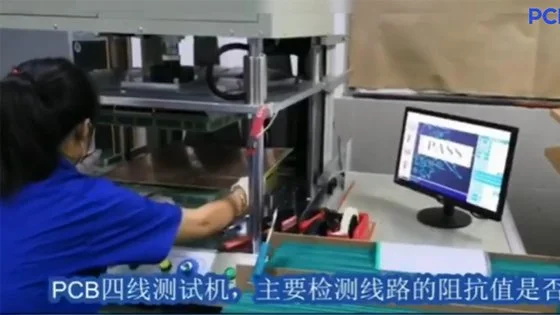
IPC Class 3 represents the highest level of quality and reliability defined by IPC (Association Connecting Electronics Industries). It applies to high-end products, and automotive and medical must follow the IPC Class 3 standards.
The IPC Class 3 acceptance standards ensure continuous high performance, no product failure, and reliability in harsh operating environments.
We verify minimum and uniform copper plating thickness, via integrity and barrel reliability, conductor spacing and insulation resistance, mechanical robustness under thermal and flex stress, and electrical continuity and low-resistance performance. Through rigorous validation procedures, including thermal stress testing, micro-section analysis, and four-terminal sensing on test coupons and critical nets, we confirm full compliance with IPC Class 3 requirements.
Partner with PCBONLINE for Rigid-flex PCB Manufacturing for Automotive and Medical
If you're looking for rigid-flex PCBs used for automotive and medical applications, work with the turnkey rigid-flex PCB manufacturer PCBONLINE. Our rigid-flex PCB capabilities and certifications match the requirements for automotive, medical, aerospace, computers, commercial, and communication industries.
Founded in 2005, PCBONLINE has two large advanced PCB manufacturing bases, one turnkey PCB assembly factory, stable supply chains, and an R&D team.

PCBONLINE has turnkey rigid-flex PCB fabrication and assembly capabilities for automotive and medical from PCB prototypes to mass assembly production.
Rigid-flex PCB fabrication requires both flex and rigid PCB fabrication lines and laser-cut equipment. PCBONLINE has complete equipment specialized for rigid-flex PCB fabrication.
The professionals from PCBONLINE can optimize rigid-flex PCB design to be the most economical without quality sacrifice for automotive and medical uses.
PCBONLINE provides free DFM (design for manufacturing) and one-on-one engineering support for rigid-flex PCB projects.
PCBONLINE does comprehensive tests ensuring the bend radius, long-term reliability, and micro resistance, including four-terminal sensing, the tension test, bending test, button strike life test, hand sweat test, environmental protection test, metallographic microscope inspection, bridge test, etc.
High-quality rigid-flex PCB certified with ISO 9001:2015, ISO 14001:2015, IATF 16949:2016, RoHS, REACH, UL, and IPC-A-610 Class 3.
The professional team at PCBONLINE specializes in creating high-quality rigid-flex PCBs for automotive and medical applications, tailored to your project's custom requirements. To get a quote for your rigid-flex PCB project, please contact info@pcbonline.com.
Conclusion
A rigid-flex PCB is not a combination of a rigid PCB and a flex PCB connection, but a flexible PCB laminated with FR4 layers. Rigid-flex PCBs used in automotive and medical applications must employ four-terminal sensing and adhere to IPC Class standards. To manufacture and assemble affordable rigid-flex PCBs for automotive and medical applications with reliability, work with the one-stop rigid-flex PCB manufacturer PCBONLINE.
PCB assembly at PCBONLINE.pdf
PCB fabrication at PCBONLINE.pdf


