

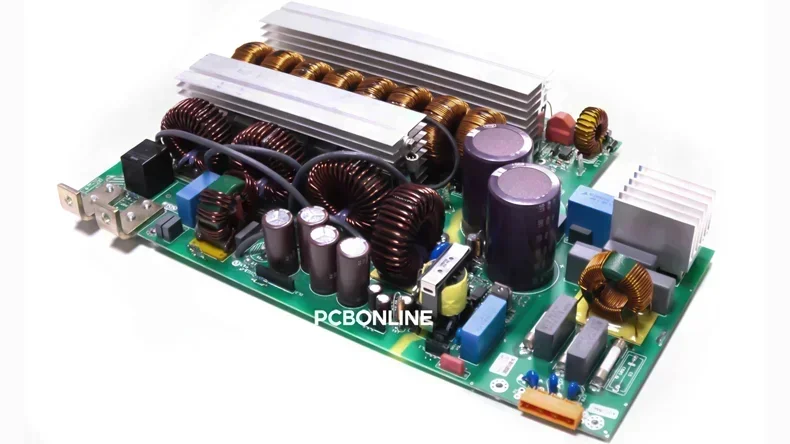
Industrial PCBs (printed circuit boards) refer to the PCBs used for industrial controls, which have to work in a high-power, high-current, and high-voltage environment. How does an industrial PCB handle high power? The industrial PCB is usually thick-copper (3oz+) and has PCB busbars or strips inlaid or surface mounted.
PCBONLINE, a high-power PCB manufacturer for industrial controls and automotive applications, provides one-stop industrial PCB production with one-on-one engineering support. We specialize in thermal management, especially the large and small current separation on the PCB. In this article, we show you how we handle the high power of industrial PCBs through our one-stop industrial PCB production.
The Challenge of High Power in Industrial PCBs
High power in an industrial PCB means we need to deal with heat and space.
According to Joule's Law, the heat generated in a conductor is proportional to the square of the current (I²R). As amperage increases, standard 1-2oz copper foils quickly reach their physical limits. If the PCB cannot dissipate this heat or carry the load, the result is catastrophic failure: delamination, charred substrates, or melted solder joints.
To overcome the heat and space challenges, industrial PCB production must move beyond standard fabrication techniques. Here is how PCBONLINE tackles these challenges: thick-copper PCBs of 3oz to 14oz, copper busbars, and other thermal strategies like using copper core and thermal vias.
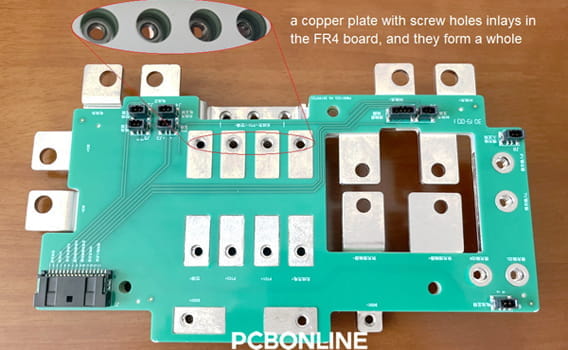
For example, in the above high-power industrial PCB, PCBONLINE separates the high-current and low-current electrical networks. The copper busbars are responsible for large current conduction and heat dissipation, and the PCB circuit layer (3oz) is responsible for small current and signal conduction.
Besides, in our industrial PCB production, we achieve an effective combination of FR4 and PCB busbars.
Thick-Copper PCBs: The Foundation of Power for Industrial PCBs
The most direct way to increase current-carrying capacity is to increase the cross-sectional area of the copper. While standard boards use 1oz (35μm) copper, high-power industrial applications require Thick-Copper PCBs, ranging from 3oz to 14oz.

By using thick copper for industrial PCBs, we increase current endurance, thermal conductivity, and mechanical strength.
Thicker traces can carry significantly higher Amperes without reaching dangerous temperature rises. Thicker layers also help spread heat away from power components like MOSFETs or IGBTs toward the PCB's edges or heatsinks. In industrial environments prone to vibration, thick copper provides added structural integrity to the circuit board.
At PCBONLINE, we specialize in the precision etching of heavy copper layers, ensuring that even at 14oz, trace accuracy and spacing are maintained to prevent short circuits. Besides, we grasp mature technology of the electrostatic spray solder mask process for thick-copper PCBs.
In industrial PCB production, we have to check the copper layer thickness and etching effect. So we have a copper thickness test and a metallographic test for industrial PCBs.

Integrating Copper Busbars for Ultra-High Current for Industrial PCBs
For high-power applications, even 14oz copper isn't enough for industrial PCBs. In industrial applications like heavy-duty motor drives or power distribution units, currents can reach hundreds of Amperes. This is where PCB busbars and PCB traces are used for large and small current separation.
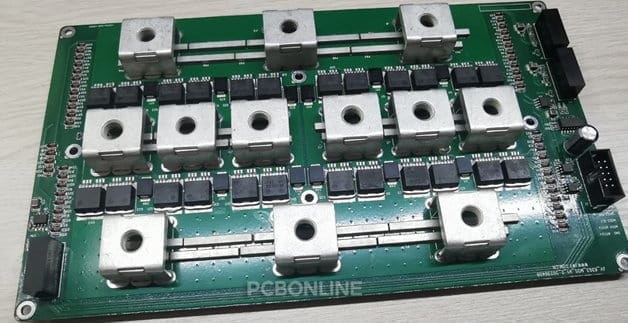
PCBONLINE can both embed and mount copper busbars directly onto or within the PCB. This hybrid approach offers several advantages:
- Maximum conductivity: Busbars provide a massive cross-section for high-current "highways," while standard PCB traces handle the delicate logic and control signals.
- Space efficiency: By integrating the busbar into the PCB assembly, we eliminate the need for bulky external wiring harnesses, reducing the overall size of the industrial enclosure.
- Reduced resistance: Direct soldering or bolting of busbars to the PCB minimizes contact resistance, which is a major source of heat in high-power systems.
Other Thermal Management Strategies for Industrial PCBs
Dealing with high power is 50% conduction and 50% cooling. Without a robust thermal management plan, even the thickest copper will eventually fail in harsh environments.
For high-power LED or power conversion applications, we often use copper-core PCBs. The copper base acts as an integrated heatsink, pulling heat directly from the components through a thin dielectric layer.

In multilayer PCBs, we implement thermal vias. Thermal vias are small, copper-plated holes that create a thermal bridge between the heat-generating component on the top layer and a heat-dissipation layer (or an external heatsink) on the bottom.
Besides, for industrial PCBs, we use high-Tg FR4. Industrial PCBs. We use high-Tg FR4 materials (Tg170, Tg180, Tg185, and Tg200). High-Tg FR4 materials can withstand higher operating temperatures without becoming brittle or losing structural integrity, ensuring a long service life for industrial equipment.
PCBONLINE Offers One-on-One Engineering Support for Industrial PCBs
High-power PCB design is complex. A minor oversight in trace clearance or thermal relief can lead to field failures. This is why PCBONLINE provides one-on-one engineering support from the prototyping stage through to mass production.
Our engineers work with you to:
- Calculate current capacity: Using advanced simulations to ensure your 3oz–14oz copper traces are perfectly sized for your specific amperage and allowable temperature rise.
- Optimize layout for separation: Ensuring that high-voltage/high-current paths are physically separated from sensitive control logic to prevent EMI issues.
- DFM (design for manufacturing): Reviewing your files to ensure that the integration of busbars and thick copper is optimized for cost-effective, high-yield production.
Industrial PCB Assembly
Due to the heavy copper and the PCB busbars, industrial PCB assembly requires higher heat inputs. While typical reflow profiles peak at around 245°C, industrial PCBs require higher peak temperatures up to 260°C - 265°C.
Besides, industrial PCBs require a large area for through-hole assembly for capacitors and heat sinks.
PCBONLINE has rich experience in high-power industrial PCB assembly. We pay attention to wave soldering fixture design, reflow and wave soldering oven temperature control, and manufacturing process design. We can also offer selective soldering to replace wave soldering if needed.

Partner with PCBONLINE for One-stop Industrial PCB Production
PCBONLINE is an OEM industrial PCB manufacturer providing free DFM and one-stop PCB production. You can work with PCBONLINE to turn your design into real industrial controls, from prototypes to mass production.
Founded in 2005, PCBONLINE has two large advanced PCB manufacturing bases, one PCB assembly factory, an R&D team, and stable supply chains for components and materials.
PCBONLINE has dominant advantages in industrial control and inverter PCBs. We can deal with power management, fixture design, temperature control, PCB optimization, and resistance control excellently.
We have comprehensive production lines and equipment for industrial PCB production, from PCB manufacturing and assembly, to tests and value-added, including four-terminal sensing, copper thickness inspection, etc.
PCBONLINE offers free DFM before and during PCBA prototyping to debug design defects and solve unexpected issues to ensure the success of your industrial PCB, including Gerber, BOM, manufacturing process design, testing, burn-in, IC programming, and enclosure.
We have advantages in high-power PCB manufacturing and assembly, including thick-copper PCBs 3oz to 14oz, copper busbars, and wave soldering for large THT components without displacement.
Our one-stop industrial PCB production capabilities include independent advanced manufacturing, 4 automatic SMT lines, 4 THT assembly, 2 X-ray inspection machines, 1 first article inspection system, conformal coating machines, burn-in cabinets, IC programmers, a component warehouse, stable supply chains, an R&D team, etc.
When your industrial control project goes to mass production, PCBONLINE will refund you the fees of R&D, prototyping/sampling, and offer free PCBA functional testing.
High-quality industrial PCB production certified with IPC-A-610 Class 3, ISO 9001:2015, IATF 16949:2016, RoHS, REACH, and UL.
PCBONLINE has manufactured many successful industrial projects for industrial control and automotive. To get a quote for your industrial PCB project, please email info@pcbonline.com. Once you contact us, we will provide you with one-on-one engineering support.
Conclusion
Industrial PCB production for high-power applications requires thermal management. By using thick-copper PCBs of 3oz to 14oz and integrated copper busbars, PCBONLINE provides the hardware foundation necessary for industrial applications. Whether you are designing a 50kW motor controller or a high-capacity power converter, our one-on-one engineering support ensures your design is reliable and efficient. To ensure the success of your industrial control, contact PCBONLINE for one-stop industrial PCB production.
PCB assembly at PCBONLINE.pdf
PCB fabrication at PCBONLINE.pdf


