

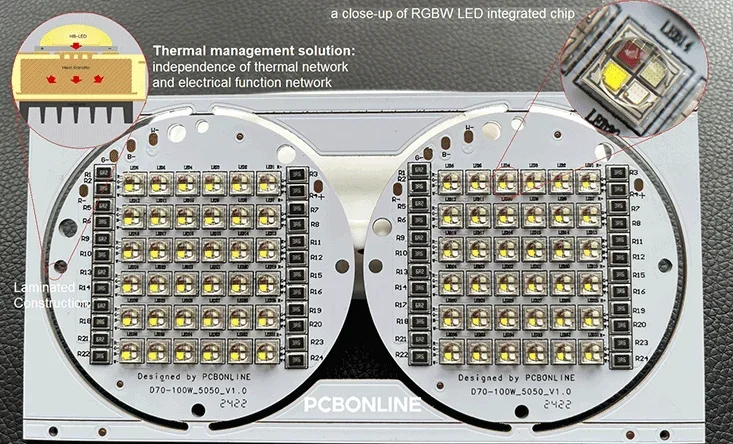
waterproof PCB designed and manufactured by PCBONLINE
What is a waterproof spray for electronics? Is it a conformal coating? Yes, it is a conformal coating or a nano-coating designed to protect a printed circuit board assembly (PCBA) from moisture. A conformal coating is a thin polymeric film that conforms to the PCBA's layout. However, most conformal coatings are water-resistant rather than 100% waterproof. They are excellent for preventing shorts from humidity, salt spray, or accidental splashes, but they aren't designed for prolonged underwater submersion.
Types of Waterproofing Sprays for Electronics
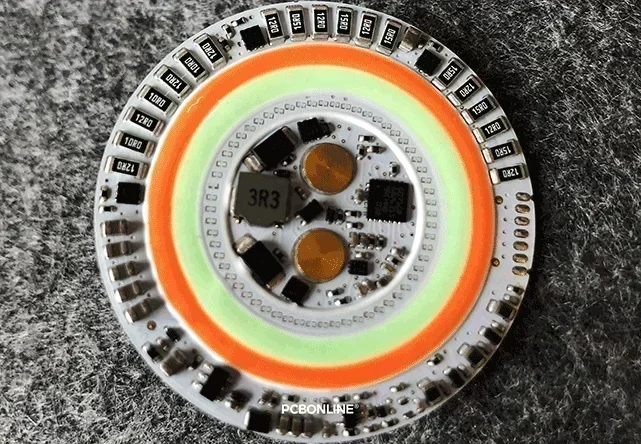
ceramic waterproof PCB manufactured by PCBONLINE for swimming pool lights
Waterproof sprays can be applied on the PCBA of a drone, a car remote, an outdoor sensor, etc, to protect the PCBA against moisture, salt spray, accidental splashes, and dust. Different conformal coatings offer different levels of protection.
- Acrylic coatings are the most common waterproof spray for electronics. They are easy to apply and easy to remove with solvent if you need to repair the PCBA later.
- Silicone coatings offer the best protection against high temperatures and are very flexible, making them ideal for environments with lots of vibration.
- Nano-coatings are ultra-thin sprays that often don't require masking of connectors. They provide hydrophobic (water-repelling) properties but may be thinner than traditional coatings.
- Polyurethane coatings feature chemical and abrasion resistance. Polyurethane is tougher than acrylic and offers excellent protection against fuel and oil, making it common in waterproofing for automotive and aerospace applications. However, it is much harder to remove for repairs.
- Epoxy coatings are the most hardcore liquid coating. It creates a rigid, rock-hard shell that provides superior protection against moisture and harsh chemicals. The trade-off is that it can shrink during curing, potentially stressing delicate components, and it is nearly impossible to remove without damaging the PCBA.
A parylene coating is applied as a vapor in a vacuum chamber, allowing it to coat 100% of the PCBA with a pinhole-free, ultra-thin layer. It is used for medical implants and deep-sea equipment where failure is not an option.
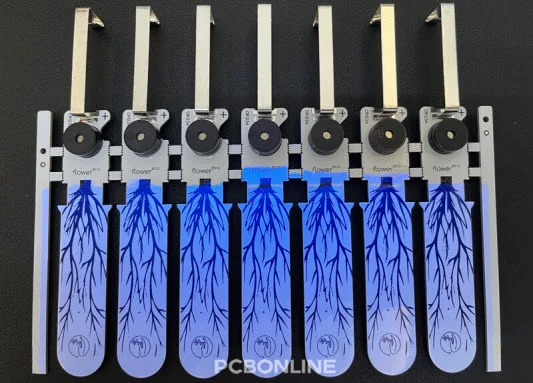
Spraying Waterproof Spraying for Electronics
Applying waterproof sprays can be done using a brush by hand or automatically spraying by an automated spraying machine. A more advanced machine can do selective spraying.
Manual application: brushing & hand spraying
This is the entry-level method, typically used for prototyping, repair, or low-volume production.
During manual brushing, an operator uses a small brush to paint the coating onto specific areas. While it is very low-cost and requires zero equipment, it is slow and prone to human error, often resulting in uneven thickness or missed spots.
Another way is hand spraying using a handheld spray gun or aerosol can. It provides a more uniform finish than a brush but requires extensive masking. You must manually tape off keep-out zones like connectors and buttons, so they don't get gummed up by the spray.
Automated spraying by machine
For medium-to-high volume PCBA conformal coatings, turnkey PCBA manufacturers like PCBONLINE use a machine with a fixed or reciprocating spray head over a conveyor belt. The jig used on the automated spraying machine is custom-designed and supplied by us.
The automated spraying machine applies the same amount of material to every PCBA, ensuring the coating isn't too thin (offering no protection) or too thick (which can crack).
Like hand spraying, standard automated machines still require masking. The spray is blind as it covers everything in its path, meaning labor is still spent applying and removing tape before and after the process.
Selective spraying
This is the most advanced method, utilizing robotic arms and specialized valves like needle valves.
The selective spraying machine is programmed with the PCBA's layout. It identifies exactly where the connectors are and moves the spray head with micrometer precision to avoid them. This eliminates the cost and labor of masking.
Because the selective spraying method only sprays where needed, there is virtually zero wasted material, which is a significant cost saver when using expensive coatings like specialized silicones or polyurethanes.
Besides, selective spraying can tilt and rotate the spray head to coat 3D structures or get under the overhangs of large components. It can achieve complex geometries of waterproofing spraying on the PCBA.
Further Waterproofing Methods for Electronics
Waterproofing spraying is not 100% waterproof, especially for electronic devices in water submersion. The further waterproofing methods are PCBA encapsulation for the critical components or even the entire PCBA, and using waterproof enclosures with the silicone O-ring and screws to secure the enclosure's entry hole of the cable harness.
PCBA Encapsulation (Potting)
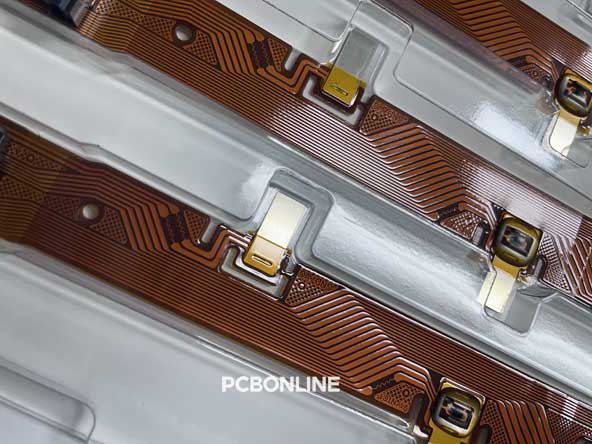
Instead of a thin film, encapsulation (often called potting) involves burying the entire circuit board inside a thick, solid block of protective resin.
The PCBA is placed inside a mold, and a liquid resin, like epoxy, Silicone, or Polyurethane, is poured over it until it is completely submerged. Once cured, the PCBA is effectively a solid brick of plastic.
Because there is no air left inside, there is no void for water to enter, even under high pressure. This makes it the preferred method for underwater sensors and marine electronics.
However, potting adds significant mass to the device. What's more, it is virtually impossible to fix a component once it is potted, as the resin must be destroyed to reach the board. Also, some resins act as insulators, so heat-generating components like CPUs may need specialized thermally conductive potting to avoid overheating.
Waterproof Enclosures (Mechanical Sealing)
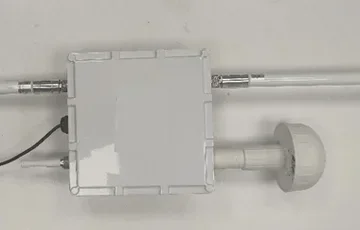
This method focuses on keeping the water out of the device entirely rather than protecting the components individually. It uses waterproof enclosures with the silicon O-ring and gasket to keep water from entering the internal.
A specialized groove in the enclosure holds a silicone O-ring. When the lid is tightened with screws, the silicone compresses, creating an airtight and watertight interference fit that can withstand significant water depth.
Using stainless steel screws ensures that the compression on the O-ring is uniform across the entire seal. The steel screw prevents warping of the plastic housing, which is a common failure point in cheaper snap-fit cases.
The most vulnerable part of any enclosure is where the wires enter. To solve this, Cable Glands (or cord grips) are used.
Together, they use a threaded body and a nut to squeeze a rubber internal seal around the cable harness. This chokes the cable, creating a seal that is often rated for IP68 (continuous submersion).
Turnkey Waterproof PCB Manufacturer PCBONLINE with R&D Capabilities
If your PCB or PCBA project needs waterproofing, no matter how humid the environment in which the device is working, you can work with the turnkey waterproof PCB manufacturer PCBONLINE from R&D to one-stop PCBA manufacturing and box-build assembly.
Founded in 1999, PCBONLINE has two large advanced PCB manufacturing bases for waterproof PCBs, one turnkey PCB assembly factory for waterproof PCB assembly and box-build assembly, stable material supply chains, and strategic cooperation with electronic component manufacturers, and long-term cooperation with the top 3 mold and enclosure manufacturers in China for jigs/textures, molds, and waterproof enclosures. Besides, PCBONLINE has an R&D team and professional CAM engineers for project development and DFM (design for manufacturing).
PCBONLINE manufactures and assembles waterproof PCBs in various materials, such as ceramic, aluminum, high-Tg FR4, and PTFE.
PCBONLINE provides one-stop electronics manufacturing for waterproof PCBs and devices, from water PCB fabrication to enclosure installation on the PCBA, from prototypes to bulk production.
Whether it is underwater with powerful water jets or a not very humid environment, like in soil or outdoors, PCBONLINE can manufacture the waterproof PCBs meeting your project requirements.
PCBONLINE provides free and professional DFM (design for manufacturing) for waterproof PCB, PCBA, and box-build projects before and during prototyping/sampling to ensure the success of your project and seamless mass production.
High-quality waterproof PCBA manufacturing certified with ISO 9001:2015, ISO 14001:2015, IATF 16949:2016, RoHS, REACH, UL, and IPC-A-610 Class 2/3.
PCBONLINE will ensure the success of your project that requires via-in-pads, solve all issues, and provide smooth BGA reballing and PCBA manufacturing.
PCBONLINE has brought out many waterproof PCBA and box build projects successfully, including automated watering PCBAs in soil, swimming pool lights, outdoor transportation cameras, highway indicator lights, airport outdoor LED displays, CCS for EV battery packs, etc. No matter what application your waterproof PCB project will be used for, such as automotive, industrial control, medical, military, aerospace, communication, agriculture, etc, you can work with PCBONLINE. To reach out to the turnkey waterproof PCB manufacturer PCBONLINE, contact info@pcbonline.com.
Conclusion
Waterproofing spraying for electronics is water-resistant but not 100% waterproof. PCBONLINE provides conformal coatings, potting, and waterproofing enclosure assembly to add value to the PCBA. To ensure the success of your waterproof PCB/PCBA projects, work with the turnkey advanced waterproof PCBA manufacturer PCBONLINE.
PCB fabrication at PCBONLINE.pdf


