

A turnkey manufacturing solution is a manufacturing model in which one supplier takes an electronic product from design files to tested, delivered products. The customer sends the Gerber files, the BOM, and the product requirements. The supplier performs DFM, sources the components, manufactures the PCBs, assembles the PCBAs, and ships finished products.
The turnkey manufacturing solution is like the following scene. A 12-layer high-speed HDI PCBs leaves our PCB manufacturing base in Jiangsu and arrives at our turnkey PCB assembly factory in Shenzhen two days later. We have already kitted the components in our warehouse, and the stencil and test plan are ready.
This guide compares turnkey manufacturing with contract manufacturing, walks through the process step by step, and closes with three PCBONLINE projects: an AI server OEM project, a smart wearable PCBA project, and an industrial gateway PCBA project.
What Are Turnkey Manufacturing Solutions in Electronics?
In electronics, a turnkey manufacturing solution covers four scopes of work under one supplier: engineering, sourcing, production, and testing.
Engineering review and DFM. The supplier's engineers check the PCB design for manufacturability and flag cost and reliability risks before production.
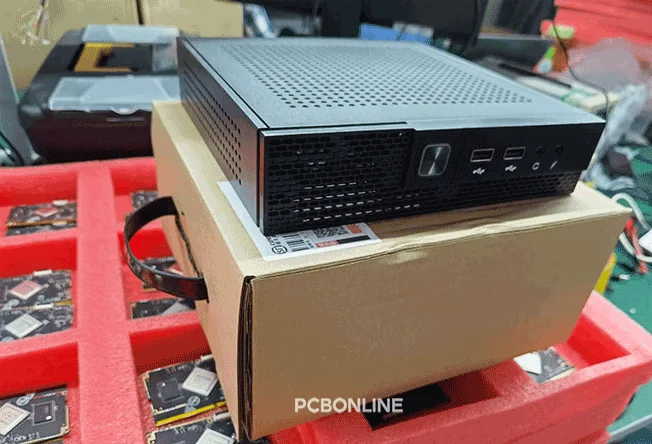
Component sourcing. The supplier purchases every part on the BOM, manages lead times, and screens for counterfeit and end-of-life risks.
PCB fabrication and PCB assembly. The supplier manufactures the bare PCBs, then performs SMT and through-hole assembly, soldering, and inspection.
Value-added services and testing. IC programming, conformal coating, functional testing, aging, and box-build assembly prepare the PCBA for the end product.
The customer keeps focus on product planning, IP, and the market. One supplier owns manufacturing execution and process control.
Turnkey Manufacturing vs. Contract Manufacturing for PCB Projects
Contract manufacturing executes the package you prepare. Turnkey manufacturing owns sourcing, engineering, and coordination from design review to delivery.
|
Scope
|
Contract Manufacturing
|
Turnkey Manufacturing
|
|
Scope
|
Production and assembly only
|
Design support to final delivery
|
|
Sourcing
|
Customer buys and consigns parts
|
Manufacturer buys and manages parts
|
|
Engineering
|
Customer resolves DFM findings in-house
|
Manufacturer's engineers review and fix
|
|
Coordination
|
Customer manages several vendors
|
One supplier, one point of contact
|
|
Failure analysis
|
Records split across vendors
|
One supplier owns the full process record
|
|
Best for
|
Mature supply chain and in-house engineering
|
Teams that want speed and one accountable supplier
|
Choose contract manufacturing when:
- 1. Your company employs purchasing staff and manages a qualified supplier list.
- 2. Your engineers resolve DFM findings in-house.
- 3. You only need extra production capacity.
Choose turnkey manufacturing solutions when:
- 1. You want one supplier accountable for the process record.
- 2. You need to shorten the launch cycle.
- 3. Your team lacks purchasing or manufacturing engineering capacity.
The cost of split ownership appears with the first field failure. A BGA void shows up after reflow on an order split between two vendors. The PCB maker checks its fabrication records, and the assembler checks its reflow data. Neither side owns the fabrication records and the reflow data together. A turnkey supplier reviews the fabrication records and the reflow data in one engineering review.
The Turnkey Electronics Manufacturing Process at PCBONLINE
PCBONLINE offers turnkey electronics manufacturing service for OEM terminal companies, solution companies, business makers, and research institutes. We complete DFM, PCB fabrication, component sourcing, PCB assembly, PCBA value-added, and testing under one roof, in six steps.

Step 1. DFM and engineering review. Our engineers review the Gerber files, the BOM, and the assembly drawings before production. They check stack-up, impedance, annular rings, solder mask dams, and panelization. They propose alternative components where a part carries lead-time or cost risk.
Step 2. Component sourcing. Our procurement team buys from component manufacturers and authorized distributors first, and buys each reel at its lowest regional price. We keep a traceability record for every component. Our warehouse controls temperature and humidity, and smart racks with barcode tracking record every movement from receiving to kitting.
Step 3. PCB fabrication. We manufacture the PCBs at our two large PCB manufacturing bases in Jiangsu and Jiangxi Provinces. Our HDI capability covers 1+n+1 to 4+n+4, any-layer interconnection to 16 layers, stacked and staggered microvias up to 5 steps, laser vias from 0.1 to 0.25 mm, and back drilling. We test every net on every production panel for continuity and isolation.
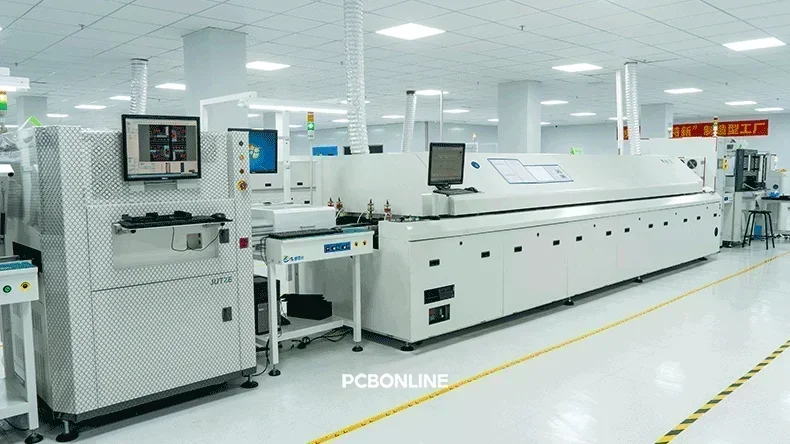
Step 4. PCB assembly. The PCBs ship to our turnkey PCB assembly factory in Shenzhen. Four automatic SMT lines print, place, and reflow, and inline dual 3D AOI inspects every PCBA before and after reflow. X-ray checks BGA and hidden joints. Every PCB we assemble goes through 3D SPI and 3D AOI on our SMT lines, and we perform a first-article inspection before volume production.
Step 5. PCBA value-added services. We program ICs before or after assembly, spray conformal coating, and assemble wire harnesses. For box-build assembly, we provide DFM for the enclosure or co-design it with you. Our long-term partner factory, one of the top three enclosure manufacturers in China, produces the enclosure to our requirements.
Step 6. Testing and delivery. We assemble to IPC-A-610 and test each PCBA against the customer's test plan: flying probe or ICT board-level testing, functional testing, and aging where the product needs it. Finished products ship by air, sea, or rail with the full process record.
Turnkey Manufacturing Solutions in Action: Three PCBONLINE Projects
Process steps describe capability. Project records prove it. The AI server PCBA, the wearable PCBA, and the industrial gateway PCBA each stress a different part of the turnkey model.
|
Project
|
Product
|
Core requirement
|
Key processes
|
Validation
|
|
AI server OEM
|
12-layer high-speed HDI PCBA, ATS power enclosure, wire harnesses
|
Tight launch schedule
|
Back-drilled HDI fabrication, DFM/DFT reviews
|
IPC Class 3 process control
|
|
Smart wearable
|
Compact PCBA with multilayer FPC
|
Integration density and low power
|
01005 placement, FPC integration, power management optimization
|
Functional testing, reliability validation
|
|
Industrial gateway
|
Wide-temperature PCBA
|
-40°C to +85°C, EMI, continuous duty
|
Wide-temperature component selection, EMC review
|
Functional testing, aging, reliability validation
|
AI Server OEM Project
The challenge. The customer needed a 12-layer high-speed HDI PCB, an ATS power enclosure, and custom wiring harnesses manufactured and integrated on a tight launch schedule. Chinese manufacturers already ship 70 to 80 percent of the world's AI server GPU PCBs, and launch windows in the AI server market keep compressing.
The solution. PCBONLINE integrated back-drilled HDI PCB fabrication, BOM sourcing, assembly, and testing in one order. Our engineers applied DFM and DFT reviews early in development and controlled the process to IPC Class 3. We co-designed the ATS power enclosure with the customer, our long-term partner factory produced the enclosure, and we assembled the custom wire harnesses in Shenzhen.
The value. We coordinated engineering, sourcing, and production in one place. The customer cut supplier handoffs and gained a predictable delivery schedule.

Smart Wearable PCBA Project
The challenge. The prototype required higher integration, lower power consumption, and reliable flexible interconnection inside a compact, space-constrained product.
The solution. We placed 01005 components, which measure 0.4 by 0.2 mm, on the SMT line and integrated a multilayer FPC into the assembly. Our engineers selected low-power components and optimized the power management section. We completed assembly, functional testing, and reliability validation in one turnkey order.
The value. The customer reached a smaller and more power-efficient product design. Each design iteration moved to manufacturing readiness faster because our engineers reviewed and assembled every revision.

Industrial Gateway PCBA Project
The challenge. The gateway had to operate from -40°C to +85°C, under strong electromagnetic interference, with continuous-duty requirements in the field. Standard commercial components carry a 0°C to +70°C rating, so the BOM needed industrial-grade replacements across several part families.
The solution. We selected industrial-grade, wide-temperature components rated -40°C to +85°C and applied high-reliability PCB fabrication and PCBA processes. Our engineers completed EMC review and testing, then functional testing, aging, and reliability validation.
The value. The customer gained a stable and scalable manufacturing solution for demanding field environments and repeatable volume production.

How to Choose a Turnkey Manufacturer for PCB Projects
Not every supplier that advertises turnkey manufacturing solutions owns the process behind the quote. Check four things before you place an order.
1. Factory ownership. Ask which processes the manufacturer owns and which ones go to subcontractors. A PCB manufacturer that subcontracts HDI drilling or X-ray inspection adds handoffs you cannot see.
2. Quality records. Ask for the process record of a recent project: first-article inspection reports, AOI and X-ray data, and electrical test results. A manufacturer with a documented process record shows the production, not the brochure.
3. Engineering depth. A turnkey manufacturer with in-house engineers reviews your files and answers with specific DFM findings, not a quote alone. Ask how its engineers review heatsink mounting loads against PCB flatness, or how they review an impedance coupon against the stack-up.
4. Certifications and standards. ISO 9001 sets the baseline. Automotive projects need IATF 16949, and medical projects need ISO 13485. Assembly workmanship should follow IPC-A-610, and Class 3 products need Class 3 process control.
Turnkey Manufacturing Solutions at PCBONLINE
PCBONLINE provides one-stop turnkey manufacturing solutions for electronic products, including DFM, PCB fabrication, component sourcing, PCB assembly, PCBA value-added services, and testing.
Founded in 2005, PCBONLINE has two large PCB manufacturing bases in Jiangsu and Jiangxi Provinces and a turnkey PCB assembly factory in Shenzhen. We serve AI and IoT, industrial control, automotive electronics, and medical electronics customers from prototypes to volume production.
HDI PCB fabrication from 1+n+1 to 4+n+4 and any-layer up to 16 layers, with back drilling for high-speed signals.
Component sourcing with alternative part proposals through our Hong Kong procurement team.
SMT assembly with 3D SPI, dual 3D AOI, and 3D X-ray inspection, and a first-article inspection before volume production.
Box-build assembly with custom enclosures and wiring harnesses.
IC programming, conformal coating, functional testing, and burn-in testing before shipment.
PCBA manufacturing certified with ISO 9001:2015, ISO 14001:2015, IATF 16949:2016, RoHS, REACH, UL, and IPC-A-610 Class 2/3.
Send your Gerber files and BOM to info@pcbonline.com, and our engineering team replies with a DFM report and a turnkey quotation.
FAQs
Q: How many layers does an AI server PCB have?A turnkey manufacturing solution is a model in which one supplier takes a product from design files to finished delivery. The supplier performs engineering review, component sourcing, PCB fabrication, assembly, testing, and logistics. The customer receives products ready for use or sale.
Q: What is the difference between turnkey manufacturing and contract manufacturing?Contract manufacturing covers production and assembly against a fixed package, and the customer manages sourcing and coordination. Turnkey manufacturing solutions cover the full process from design support to delivery, and the manufacturer owns sourcing, engineering, and process control.
Q: What files do I need to start a turnkey PCB assembly order?You need the Gerber files, the BOM, the pick-and-place or centroid file, and the assembly drawings. For tested products, add the test plan and firmware files. A turnkey manufacturer reviews the file package and returns DFM findings with the quotation.
Q: Is turnkey manufacturing more expensive than consigned assembly?Unit prices can look higher because the quote includes components and management. Total project cost often drops because one supplier removes coordination delays, consignment shortages, and cross-vendor failure disputes.
Q: Can a turnkey manufacturer support both prototypes and volume production?Yes. A turnkey manufacturer with in-house PCB fabrication and SMT lines uses the same process for prototype quantities and volume orders. The prototype stage validates the DFM decisions, and volume production repeats the validated decisions under one process record.
PCB assembly at PCBONLINE.pdf


