

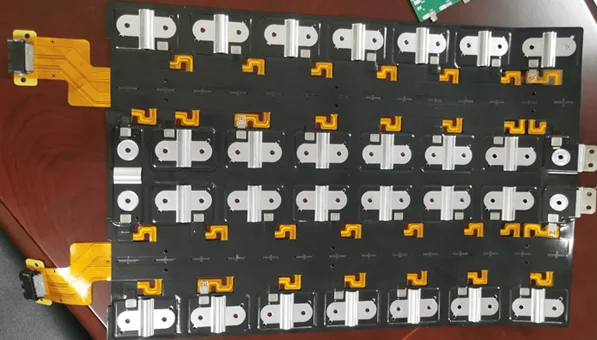
When people mention PCB assembly flexible, they talk about flexible PCB assembly or PCB (printed circuit board) assembly with flexible manufacturing capabilities prvided by the PCBA house.
Flexible PCB is also called FPC (flexible printed circuit). Flexible PCBs are lightweight and thin and can fit devices with compact and awkward spaces. They are made by PI or PET materials and copper foil.
PCB assembly flexible means rigid PCB assembly where the PCBA manufacturer providing PCB assembly services in different quantities for different production stages, meeting their clients's demands. Their clients requiring PCB assembly with fleixble manufacturing are usually OEMs (original equipment manufacturers) that develops the product and owns the brand.
FPC Assembly

Choosing the right substrate is the first step in successful flex PCB assembly.
Polyimide is the most common material used in flex PCBs. PI flex PCBs offer better flexibility, thermal stability, and mechanical strength. PI can withstand high temperatures and is compatible with lead-free soldering processes. Choose PI flexible PCBs for complex circuits, aerospace, and automotive sensors.
Compared with PI, PET is fragile and can't bend arbitrarily as PI does, but it is transparent. Choose PET flexible PCBs for transparent applications. PET has a much lower melting point than PI, requiring low-temperature reflow soldering.
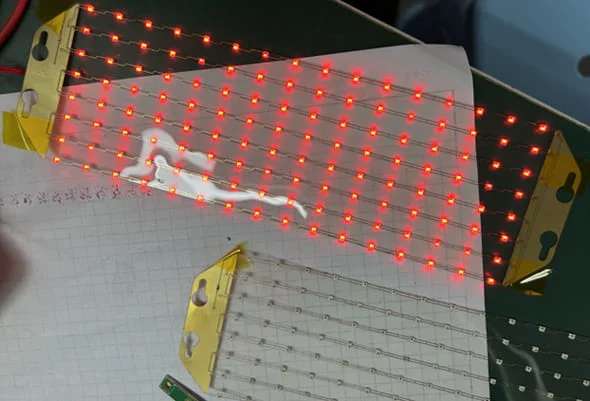
Challenges and Solutions in FPC Assembly
Assembling components onto a flexible PCB has to overcome thw issue that the flex PCB can warp, stretch, or shrink during the assembly process:
- Dimension stability: PI and PET materials expand and contract with temperature changes, causing misalignment between the PCB pads and the components.
- Handling: Unlike rigid PCBs, flex PCBs cannot be easily transported through automated tracks without support.
- Heat management: Applying too much heat can melt PET or cause PI to delaminate.
Flex PCB assembly solutions
To overcome FPC assembly challenges, the PCBA manufacturer PCBONLINE provides custom fixtures and SMT assembly with precise temperature control specifically for FPCs (flexible printed circuits).
1. Custom fixtures
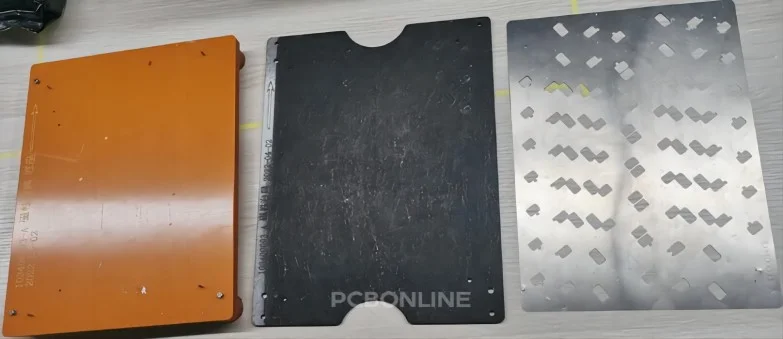
Since flexible PCBs lack rigidity, we use precision-designed fixtures, which are magnetic or non-magnetic.
Magnetic fixtures include a magnetic pallet and a steel sheet. The flexible PCB is clamped between them during the entire flex PCB assembly process.
A non-magnetic fixture is only the pallet. The flexible PCB is attached to the pallet with high-temperature tapes.
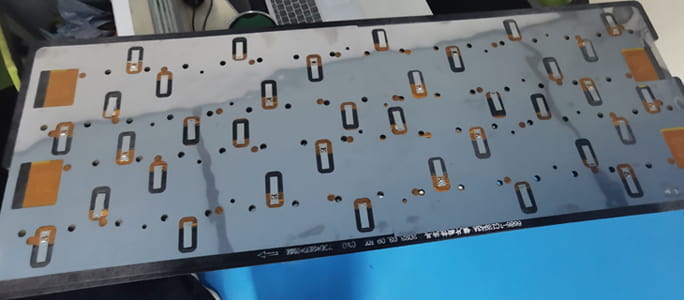
Before flex PCB assembly, the pallet is placed on a base fixture with pin snags for accurately placing the FPC. When the FPC is correctly fixed on the pallet, we remove the base fixture and put the pallet that carries the flexible PCB onto the SMT line.
2. High-precision SMT
At PCBONLINE, there are 4 automated SMT lines offering flex PCB assembly. Each is equipped with dual AOI systems, precision PNP machines, and a lead-free reflow oven.
Our pick-and-place (PNP) machines are Yamaha YSM20R and YSM10, ensuring components as small as 01005 are placed with surgical precision.
We have AOI (automated optical inspection) both before and after the reflow oven. This dual-stage verification catches bridge defects or shifted components before they become permanent.
3. Low-temperature reflow control
Thermal management is where PCBONLINE excels. We operate lead-free reflow ovens with customizable temperature profiles.
- PI flex PCB reflow: For Polyimide boards, we typically maintain a reflow peak of about 180°C. This ensures a strong solder bond while protecting the integrity of the PI substrate.
- PET flex PCB reflow: PET cannot handle standard reflow temperatures. To solve this, PCBONLINE utilizes an innovative approach: we often use the residual heat from other PCB reflow runs or specialized low-temperature solder pastes to bond components to PET FPCs. This prevents the substrate from deforming or melting.
FPC Assembly Process
Our flexible PCB assembly maximizes yield and minimizes the stress placed on the flexible substrate.
Step 1: Placing the flex PCB on the fixture
We place the pallet on the base fixture first, and then position the flexible PCB on the pallet. When the flex PCB is fixed correctly on the pallet, we remove the base fixture and put the pallet that loads the FPC onto the SMT line.
Step 2: Solder paste printing
In the solder paste printing machine, high-quality solder pastes are ready on the custom-designed SMT stencil. The scrapper presses the solder paste through the holes of the SMT stencil. Then the paste is deposited exactly on the pads of the FPC secured in the fixture.
Step 3: Component placement
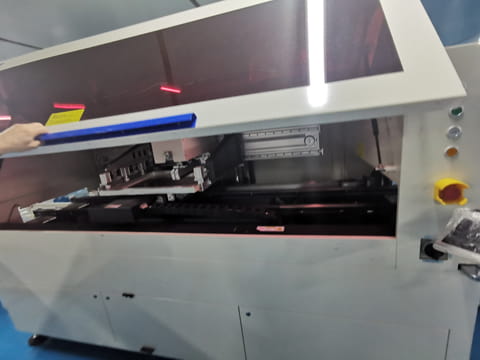
Our PNP machines use vision systems to align components based on the FPC's fiducial marks. This compensates for any minor material stretching.
Step 4: Pre-reflow AOI
Before reflow soldering, there's an AOI machine to scan the solder paste on the FPC pads to ensure the solderability to prevent economic losses.
Step 5: Reflow soldering
The FPC passes through our 10-zone lead-free reflow oven. Each zone is meticulously monitored. The ramp-up and cooling rates are strictly controlled according to our reflow profile.
Step 6: Pro-reflow AOI
After reflow soldering, the FPC assembly is scanned by the AOI machine to ensure no soldering defects on the surface.
Step 7: Testing
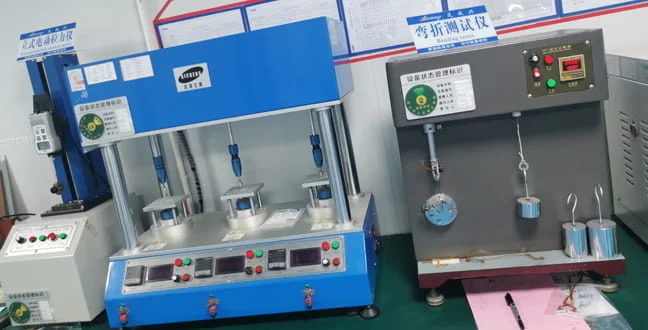
After assembly, we remove the fixture from the FPC. We then perform rigorous testing, including a functional test to ensure the PCB performs its intended electrical tasks and a bending test to ensure the solder joints remain intact when the PCB is flexed in its final application.
Besides the functional test and bending test, PCBONLINE offers the tension test, button strike life test, hand sweat test, solder joint pull strength test, environmental protection test, metallographic microscope inspection, bridge test, fuse fusing test, and salt spray test.
PCB Assembly with Flexible Manufacturing
The other possibible meaning of PCB assembly flexible is that the PCB asesembly house has flexible manufacturing capabilities to provide PCB assembly in any volume, from prototype and small batches like 5 and 10 boards to high volumes like 1,000,000 boards.
In flexible PCBA manufacturing, there's only the quantity differency. PCBAs in different batches and volumes must stay quality consistency, so the assemblu house must use the same SMT and THT assembly lines and follow the same standards and proces to different volumes.

Flexible manufacturing capabilities require the PCB assembly house to have quick-turneky PCB assembly and provide the first article inspection before bulk production.
Quick-turn PCB assembly means the PCB assembly house with flexible PCBA capabilities should be able to complete PCB assembly within 1 working day. This is possible if the client has confirmed the PCB design and all correct files, and the assembly house has all the components for the PCBA in their component warehouse stock.
PCBONLINE stores over 100,000,000 components in the warehouse, including all basic passive components and hundreds types of active components frequenctly used.
For an expedited order, whether it is prototype assembly or mass production, we can complete quick-turn PCB assembly in 1 to 3 working days.
One-stop PCB Assembly Flexible from PCBONLINE
If you're looking for flexible PCB assembly, or if you want PCB assembly with flexible manufacturing, including R&D, FPC/PCB manufacturing, and assembly, partner with PCBONLINE. Founded in 2005, PCBONLINE has an FCCL factory, two advanced PCB manufacturing bases, and a turnkey PCB assembly factory, with stable supply chains and an R&D team.
PCBONLINE has turnkey flex PCB fabrication and assembly capabilities. We not only fabricate and assemble FPCs, but also provide flex PCB copper-clad laminates custom for FPC fabrication.
PCB Assembly in flexible manufacturing for both prototypes and mass production, including quick-turn PCB assembly in 1 to 3 working days.
PCBONLINE does comprehensive tests, such as ensuring the bend radius, the tension test, the bending test, the button strike life test, the hand sweat test, the environmental protection test, the metallographic microscope inspection, the bridge test, etc.
PCBONLINE has flex PCB R&D capabilities and can do the FPC design or take part in your project's development from the early stage.
PCBONLINE provides free DFM (design for manufacturing) and one-on-one engineering support for FPC projects, including FPC layout optimization.
High-quality flex PCB assembly certified with ISO 9001:2015, ISO 14001:2015, IATF 16949:2016, RoHS, REACH, UL, and IPC-A-610 Class 2/3.
The professional team at PCBONLINE specializes in thermal management, signal integrity, fixture design, and manufacturing process control. We ensure the flex PCB assembly is tailored to your project's custom requirements. To get a quote for your flexible circuit project, please contact info@pcbonline.com.
Conclusion
Flex PCB assembly requires custom fixtures and thermal precision in reflow soldering. Whether you require the PI or PET flex PCB assembly, PCBONLINE has the technology and the expertise to deliver turnkey services. To manufacture flexible circuits with reliability at reasonable costs, work with the one-stop flex PCB manufacturer PCBONLINE.


