

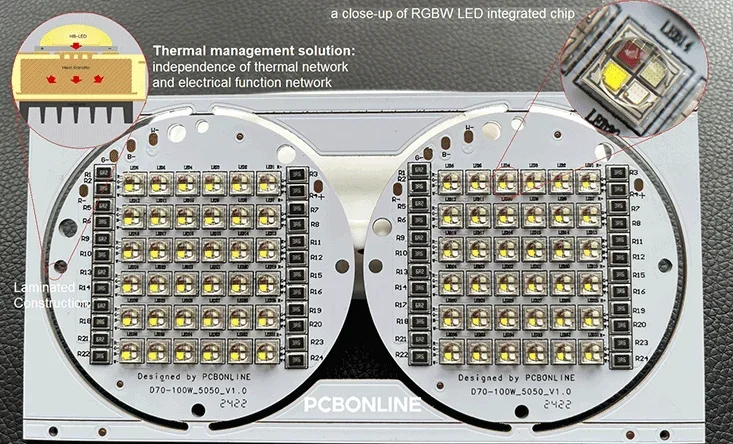
Metal core printed circuit boards (MCPCBs) can be used in cost-effective electronic equipment that demands efficient heat dissipation. Among all metal-based PCBs, aluminum PCBs and copper-core PCBs are the two most widely used options.
As a professional turnkey PCB manufacturer, PCBONLINE produces and assembles aluminum MCPCBs and high-performance copper-based MCPCBs, offering a full range of material choices, custom stackups, and precision manufacturing.
In our article, we provide an in-depth explanation of metal core PCB materials, including the aluminum core vs copper core, insulation prepreg material, and choosing MCPCB material thermal conductivity based on the PCB thickness and substrate option.
Metal Core PCB Materials
Metal core PCB (MCPCB) materials use an aluminum or copper plate as the PCB substrate to improve thermal conductivity. They are used in high-power applications, such as LED lighting, automotive electronics, power modules, and solar energy battery modules.
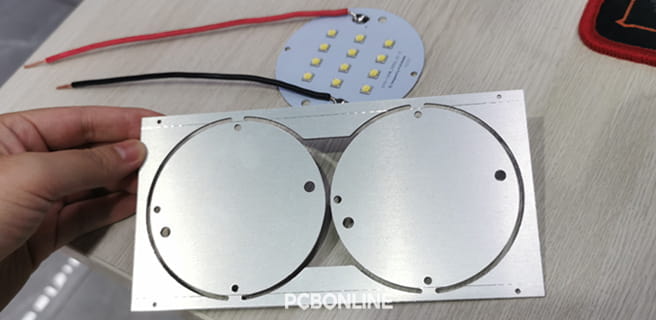
Besides the aluminum or copper plate as the PCB substrate, metal core PCB materials include the copper foil that is etched as circuit layers and polymer filled with ceramic powders that is used as dielectric insulation layers.
- Copper foil: The copper foil thicknesses for MCPCBs include 35μm, 70μm, 105μm, 140μm, 210μm, and 280μm. Thicker copper allows higher current-carrying capacity, lower trace resistance, and better thermal spreading.
- Dielectric materials: Dielectric layers determine the thermal performance of the MCPCB. PCBONLINE's MCPCB dielectric materials are ceramic-filled polymer (alumina + silicon powder) with an epoxy-based matrix. They have low thermal resistance as low as 0.15°C/W, excellent viscoelasticity, strong resistance to thermal aging, and high mechanical and thermal stress tolerance.
- Metal substrate (aluminum or copper plate): The aluminum or copper base plate functions as the main heat spreader, providing structural support, EMC shield, and ground plane. Among MCPCB types, aluminum is the most common, but copper offers the highest performance and reliability, especially when dealing with high heat and high-frequency circuits. Copper supports drilling, punching, and routing.
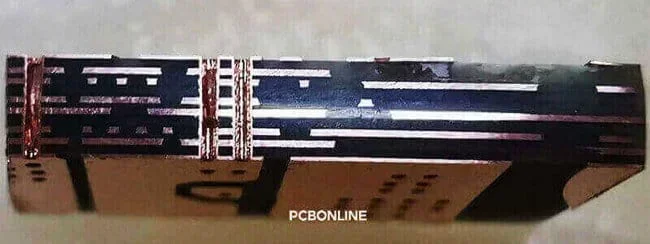
Aluminum Substrate vs. Copper Substrate
Aluminum MCPCBs are cost-effective and offer reasonable thermal conductivity, typically between 1–3 W/m·K, depending on the dielectric material. They are widely used in LED lighting, power driver boards, consumer electronics, and low- to medium-power thermal management devices.
MCPCBs with copper substrates are premium high-performance MCPCBs, yet more expensive. The copper substrate is a capable metal substrate, enabling the PCB to offer thermal conductivity 2× higher than aluminum.
Copper-based MCPCBs are advanced and premium metal core PCBs. Besides the same application, aluminum PCBs are used; copper MCPCBs can be used in High-power LED and laser modules, areas with extreme temperature variation, precision communication equipment, and industrial and architectural thermal applications.
PCBONLINE provides copper-based MCPCBs in various thicknesses, including 0.8mm, 1.0mm, 1.2mm, 1.6mm, and 2.0mm, ensuring compatibility with a wide range of thermal and mechanical requirements.
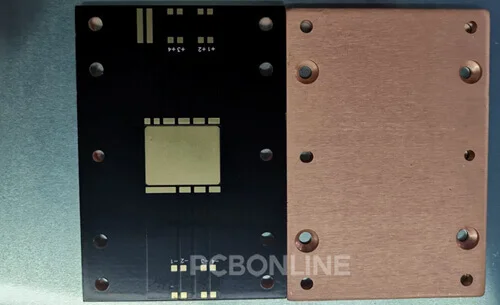
Copper substrate is superior to aluminum substrate in performance.
1. Copper has twice the thermal conductivity of aluminum, so a copper substrate provides higher thermal conductivity, faster heat spreading, lower thermal resistance, better device reliability, and excellent heat dissipation for high-power applications.
2. Copper substrates support metallized vias. Metallized vias that are plated allow multi-layer interconnection, better grounding, and lower impedance signal return paths. By contrast, aluminum substrates cannot support metallized vias, because aluminum is not suitable for the PTH process.
3. Copper is solderable, so PCBs using a copper plate can be hybrid laminated with other materials, such as ceramic. We can also use soldering during final assembly to create more flexible product designs. In contrast, an aluminum substrate can't do that.
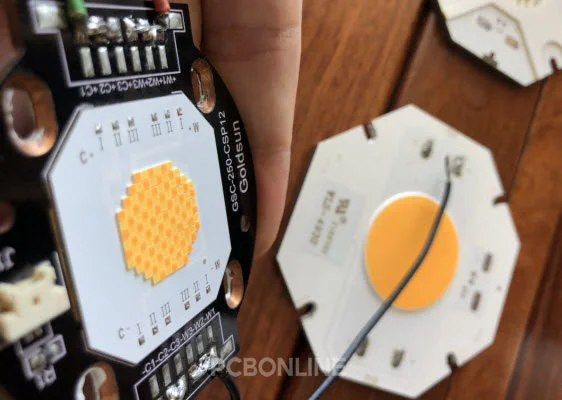
4. Copper can be etched into fine patterns and raised platforms. Copper substrates allow precision etching of fine circuit patterns and etched raised pads/pedestals for direct component mounting. Mounting components directly onto copper pedestals provides better grounding, better mechanical stability, and direct heat conduction pathways to the metal base.
5. Copper substrates provide better dimensional stability with less warpage than aluminum substrates. The elastic modulus of copper is 121,000 MPa, while of aluminum is 72,000 MPa, so copper is much stiffer, and copper MCPCBs have less warpage and shrinkage, providing more stable thermal cycling performance. This is ideal for high-precision communication devices.
How about the advantages of aluminum substrates over copper substrates? The price. Aluminum PCBs are much cheaper than copper-core PCBs and are one of the cheapest printed circuit boards.
MCPCB Materials Available at PCBONLINE
Among the many in-stock PCB laminates at PCBONLINE, there are a variety of high-quality insulated metal substrate PCB materials, including Shengyi SAR15, Ventec VT-4B3, Ventec VT-4B5, Ventec VT-4B7, Polytronics TCB-4, and Polytronics TCB-8.
|
MCPCB material
|
Feature
|
MCPCB uses
|
|
Shengyi SAR15
|
Thermal conductivity 1.0–3.0 W/m·K, cost-effective, used for LEDs and automotive lights.
|
Aluminum PCB mainstream laminate
|
|
Ventec VT-4B3
|
Thermal conductivity 1.0–3.0 W/m·K, common aluminum PCB material
|
Mainly used in LED aluminum PCB
|
|
Ventec VT-4B5
|
Common aluminum PCB material, can be used for high-power LEDs and power modules
|
Mid to high-end aluminum PCBs
|
|
Ventec VT-4B7
|
The most recommended PCB material for copper-core PCBs, used for high-power, RF, MOSFET, and IGBT applications
|
Used in copper-core PCBs and high-end aluminum PCBs
|
|
Polytronics TCB-4
|
Lower cost than Ventec, thermal conductivity of 1-3 W/·K, used for aluminum PCBs
|
Cheap and simple aluminum PCBs
|
|
Polytronics TCB-8
|
Higher conductivity than TCB-4, used for high-power lights or automotive lighting
|
mid-end aluminum PCBs and can be used in copper-core PCBs
|
Choosing MCPCB Material Thermal Conductivity
Thermal conductivity is the most important metric for metal core PCBs. PCBONLINE's suggestions on determining metal-core PCB thermal conductivity are based on PCB thickness and substrate options:
Double-sided aluminum PCBs with thermal conductivity of 2W/m·K, PCB thickness within 2.0mm.
Single-sided aluminum PCB, thermal conductivity 3W/m·K, PCB thickness within 3.0mm.
Single-sided copper-core PCB, thermal conductivity 3W/m·K, PCB thickness within 4.0mm.
If you need copper-core PCBs with thermal conductivity of 5W/m·K to 8W/m·K, there's a minimum order quantity of a few hundred laminates or a few hundred square meters.
Besides,the MCPCB minimum drill diameter must be 0.4mm or above.
Partner with PCBONLINE for OEM Metal-Core PCBs
If you need one-stop metal-core PCB manufacturing and assembly, you can partner with PCBONLINE. PCBONLINE is an OEM PCB manufacturer that provides metal core PCBs, including copper-core PCBs from 1 to 8 layers, aluminum PCBs from 1 to 4 layers, and single-layer flexible aluminum PCBs.

Founded in 2005, PCBONLINE has two large advanced PCB manufacturing bases, one PCB assembly factory, stable supply chains, and an R&D team for one-stop PCBA manufacturing.
PCBONLINE provides MCPCB manufacturing and assembly of excellent thermal dissipation: aluminum PCBs from 1 to 9W/m·K, copper-core PCBs from 2W/m·K to 398W/m·K (components directly mounting on copper pedestals).
We maintain strategic cooperation with the MCPCB material manufacturer Ventec, providing cost-effective metal-core PCB materials and streamlining our MCPCB manufacturing.
PCBONLINE offers free design for manufacturing (DFM) for your PCB and PCBA project, including checking Gerber, bill of materials (BOM), testing files, and solving all technical and unexpected issues during prototyping to ensure the smooth and successful massive production.
PCBONLINE can do the R&D for your PCBA project or take part in your project's development from the early stage for the optimum PCB design and prevent tricky problems in the field application engineering (FAE) stage.
One-stop PCB services meeting your custom needs, including prototyping/sampling, PCB manufacturing, component sourcing, PCB assembly, PCBA value-added, enclosure, and box-build assembly.
High-quality advanced PCB manufacturing certified with ISO 9001:2015, ISO 14001:2015, IATF 16949:2016, RoHS, REACH, UL, and IPC-A-600 Class 2/3.
No matter what power applications of your metal-core PCB are, like automotive, architectural lighting, consumer electronics, solar energy systems, or RF applications, PCBONLINE can produce and assemble MCPCBs that meet the highest performance and reliability standards. To get a quote for your MCPCB project, contact info@pcbonline.com.
Conclusion
Metal-core PCB materials include the dielectric materials, copper foil, and aluminum/copper plates. If you need technical support, stackup review, DFM analysis, or prototyping for metal core PCBs, our engineering team is ready to help. PCBONLINE can provide one-stop PCB manufacturing for you.
PCB assembly at PCBONLINE.pdf
PCB fabrication at PCBONLINE.pdf


