

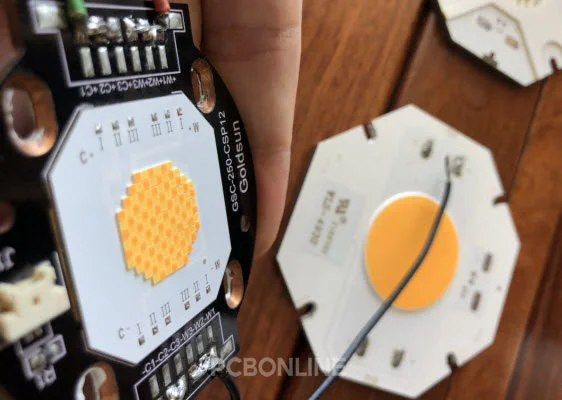
LED light circuit boards are surface-mounted with LED SMDs and other components, or the LED dies can be directly bonded onto the PCB (wire bonding, flip-chip bonding). The PCBA manufacturer PCBONLINE provides turnkey PCB assembly for LED light circuit boards. We provide SMT assembly and chip-on-board assembly for LED lights while customizing the LED light colors for prototypes and mass production.
|
Feature
|
SMT assembly
|
Wire bonding (COB)
|
Flip-chip (COB)
|
|
Heat management
|
Moderate
|
Good
|
Excellent
|
|
Profile height
|
High
|
Low
|
Lowest
|
|
Light density
|
Lower (spaced out)
|
High (dense clusters)
|
Highest
|
|
Cost
|
Low (standardized)
|
Moderate
|
Higher (precision)
|
Surface-Mount LED Circuit Board Assembly
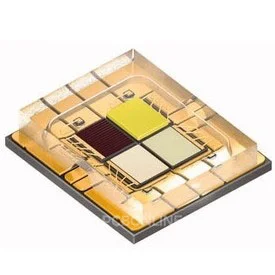
SMT assembly is a common assembly method for general lighting and electronics. The LED manufacturer first sources the LED surface mount device (SMD), which packages the LED die into a ceramic or plastic housing with metallic leads and a protective silicone lens.
With the PCBs and the SMDs ready, at the turnkey PCB assembly factory of PCBONLINE, our four automated SMT lines offer SMT assembly for LED lights.
Each of our SMT lines includes a solder paste printing machine, a solder paste inspection machine, three pick-and-place (PNP) machines, a pre-reflow automated optical inspection (AOI) machine, a reflow soldering oven, and a pro-reflow AOI machine.
The PCB is printed with solder paste and then scanned to ensure the solder paste printing effect. Two high-speed PNP machines and one functional PNP machine align the packaged LEDs onto the pads. Next, the circuit board is scanned to ensure the PNP effect without reflow risks. The circuit board then passes through a reflow oven, where the solder melts to create a permanent bond. Finally, the PCBA is scanned to ensure no soldering defects on the surface.
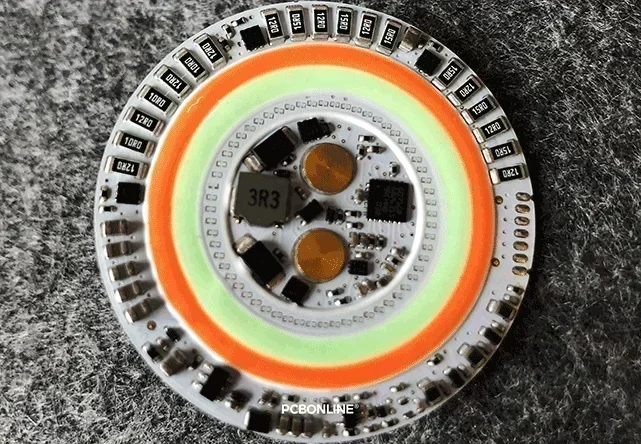
SMT assembly for LED lights is versatile. Since the LEDs are pre-packaged, they are robust and easy to handle. You can easily mix different colors or components on the same PCBA.
Direct Die Bonding (COB Assembly)
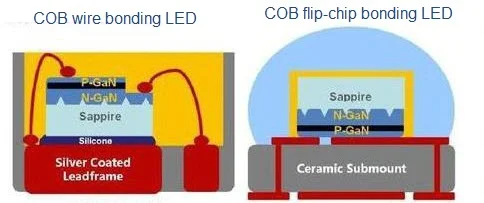
In the direct die bonding method, the packaging step is skipped as the bare LED semiconductor (the die) is attached directly to the PCB. The LED PCB is a metal-core PCB (MCPCB) or ceramic PCB for better heat dissipation. This method of directly binding the LED dies onto the PCB substrate is Chip-on-Board (COB), which includes two technologies: wire bonding and flip-chip bonding.
A. Wire Bonding
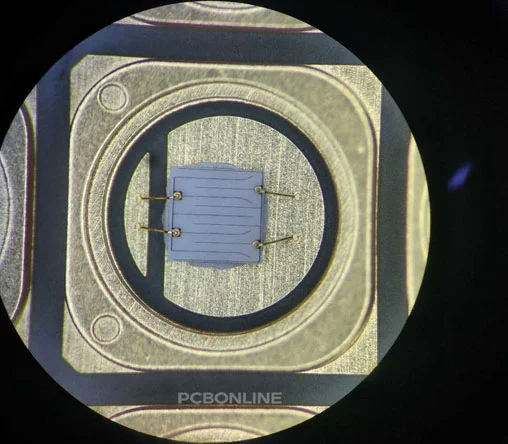
Wire bonding is the traditional method of connecting a bare die to a substrate. The LED die is glued to the PCB using a thermally conductive adhesive. A very thin gold or aluminum wire is then stitched from the top of the LED die to the contact pads on the PCB using ultrasonic energy or heat.
Wire bonding is a proven, reliable technology, but the wires are fragile and can be a point of failure. The wires also slightly block the light emitted from the top of the chip.
B. Flip-Chip Bonding
Flip-chip is a more modern, high-performance evolution of direct bonding. The LED die is flipped upside down. The electrical contacts are located on the bottom of the chip and are bonded directly to the PCB pads using solder bumps or conductive adhesive.
Flip-chip bonding has been more and more popular for LED light circuit board assembly due to the following advantages:
- Superior heat dissipation: Heat travels directly from the chip to the board without passing through a sapphire substrate or wire.
- No wire shadows: Since there are no wires on top, the light output is unobstructed.
- Higher current: They can be driven at higher currents because they stay cooler.
In the Chip-on-Board (COB) manufacturing process, once the LED dies are bonded to the PCB via wire or flip-chip bonding, they are extremely vulnerable to the environment. PCBONLINE and other high-end PCB manufacturers use a two-step encapsulation and potting process to transform the delicate semiconductors into a durable, customized lighting module.
The encapsulation process (glob-top)

Encapsulation usually refers to the Glob-Top or "Dam and Fill" method. A high-viscosity epoxy is dispensed directly over the LED dies and their fragile wire bonds. The encapsulation process includes damming, filling, and curing.
Damming: A thick epoxy that doesn't flow easily is dispensed in a ring around the LED cluster.
Filling: A lower-viscosity, optically clear epoxy is poured inside the dam. This fills the space, completely surrounding the dies and wires without leaving air bubbles.
Curing: The LED circuit board is baked in an oven at around 125°C to 150°C or exposed to UV light to harden the epoxy into a permanent, rock-hard protective shell.
Potting for seal-and-shield
While encapsulation protects the dies, potting involves placing the entire PCBA into a housing or "pot" and filling the remaining cavity with resin.
Potting creates a hermetic seal. It is the primary reason COB LEDs can be rated for IP67 or IP68 waterproof use.
The epoxy resin is chemically inert, meaning it won't react with sulfur, moisture, or industrial cleaners that typically cause LEDs to yellow or corrode.
Potting acts as a shock absorber. Because the resin is a solid block, it prevents the components from vibrating loose in high-impact environments like automotive or aerospace applications.
Besides, PCBONLINE can customize the epoxy color to change the light's characteristics.
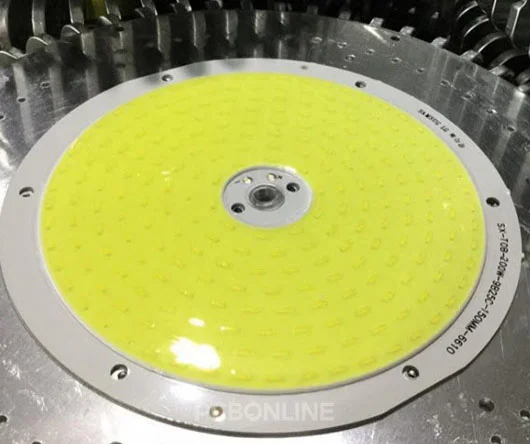
- Color temperature: Adding specific ratios of phosphors into the epoxy to convert blue light into Warm White 2700K or Cool White 6500K.
- Color quality: Mixing specialized Red or Green phosphors to achieve a High Color Rendering Index.
- Light diffusion: Adding frosted or diffusing agents to the epoxy to create a dot-free look where the light appears as one solid beam.
- Thermal conductivity: Using ceramic-filled epoxies to help pull heat away from the chips faster than standard clear resin.
One-stop LED Light PCB Manufacturer and Assembler
If you want PCB fabrication and manufacturing for your LED application, work with the high-quality LED PCB manufacturer PCBONLINE that provides one-stop electronic manufacturing services, including prototypes/samples, R&D, PCB fabrication, component sourcing, PCB assembly, PCBA value-added, and LED light box-build assembly.
Founded in 1999, PCBONLINE has two large advanced PCB manufacturing bases, one EMS PCB assembly factory, stable supply chains, and an R&D team.
PCBONLINE manufactures all types of LED light PCBs meeting your custom demand, including aluminum PCBs, copper-based PCBs, ceramic PCBs, FR4 PCB, and flexible LED PCBs.
Strong LED light assembly capabilities. Both SMT assembly and COB (wire bonding and flip-chip) are available.
PCBONLINE offers one-on-one engineering support and free design for manufacturing (DFM) and will solve all technical issues to ensure the smooth and successful production ready for bulk manufacturing.
As a source factory manufacturer, the LED light PCBs and PCBAs from PCBONLINE are cost-effective with a 98% in-time delivery rate.
High-quality LED light PCB manufacturing certified with ISO 9001:2015, ISO 14001:2915, IATF 16949:2016, RoHS, REACH, UL, and IPC-A-600 Class 2/3.
To get a quote for one-stop LED light PCB manufacturing, please contact info@pcbonline.com. No matter what quantity of LED light boards you want, PCBONLINE can work for you with high quality and reliability.
Conclusion
LED light PCBs transform how we illuminate our world. By understanding the types of LED PCBs and considerations in their design and manufacturing, you can make the right choice for any innovative and modern lighting solutions. To get one-stop LED light PCB fabrication and assembly until you receive the finished LED lighting products that have been tested to work successfully, work with the high-quality LED light PCB manufacturer PCBONLINE.
PCB assembly at PCBONLINE.pdf
PCB fabrication at PCBONLINE.pdf


