

A prototype that powers on does not make a product ready for volume orders. Between the first working sample and mass production, a box build assembly project passes three validation stages. EVT proves the engineering concept. DVT proves the controlled design. PVT proves the production system.
Each stage uses different samples, different methods, and different evidence. This article explains the validation work at each stage from the factory side, and lists the records a buyer should request from a box build assembly partner.
What Box Build Assembly Covers in a Turnkey Project
Box build assembly turns tested PCBAs into finished, sellable products. In a turnkey project it comes after PCB fabrication, SMT assembly, and PCBA testing, and before packaging and shipment.
The scope of box build assembly
A box build assembly covers the enclosure, the tested PCBA, wire harnesses, displays, sensors, thermal parts, fasteners, labels, firmware loading, and final packaging. Operators join these validated subassemblies into one unit. The line then loads the firmware, performs the end of line test, applies the serial labels, and packs the product.
Why the whole product needs validation.
A PCBA can pass every electrical test and still fail inside the enclosure. Cable routing, heat in a closed case, connector access, and screw torque only show their effects after integration. EVT, DVT, and PVT exist to catch these problems at the earliest and cheapest point in the project.
EVT in Box Build Assembly: Proving the Engineering Concept
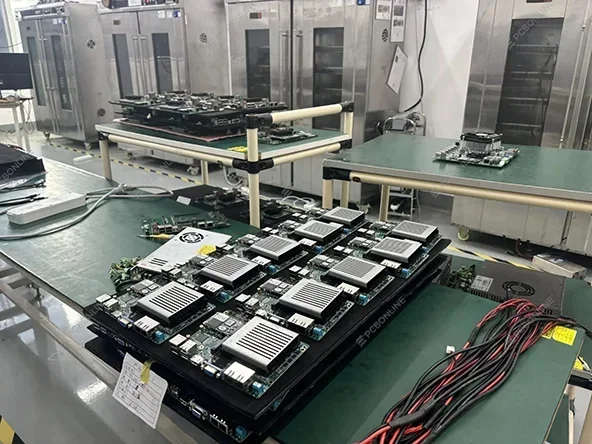
EVT is the first full integration of the product. Electronics, enclosure parts, cables, firmware, and power come together for the first time, and this stage proves the technical architecture works.
EVT
EVT checks the core functions first. It then checks the cooperation between the electronics, the structure, and the firmware. Power consumption, temperature rise, signal integrity, and communication performance get measured against the design targets. Component and material choices, fit and tolerance conflicts, and basic manufacturability and testability close the list.
EVT units do not need final tooling. 3D printed covers, soft tooling, and hand assembly work fine, as long as the sample supports the engineering conclusion of this round. A thermal test needs representative materials, heat sources, and heat paths. A firmware communication test does not depend on cosmetic parts.
Design changes are cheap at EVT.
EVT permits major design changes. A fix in a drawing costs hours. The same fix after steel tooling costs weeks. The worst outcome is an unsolved architecture or connection problem carried into DVT to save a few days.
EVT exit criteria. Main functions and key performance items have verified results. Major technical risks have conclusions. Every open issue has an owner and a fix plan, and the DVT design revision, the BOM, and the DVT test plan are ready before the stage closes.

DVT in Box Build Assembly: Verifying the Controlled Design
DVT moves the question from the concept to the complete design. The samples now represent the mass production design, and this stage verifies the product against every requirement.
DVT needs a frozen, traceable configuration before testing. The baseline covers the hardware revision, the firmware version, the BOM, the drawings, the tooling status, and the supplier status. Without a stable baseline, results from different samples cannot be compared, and the results cannot support a production decision.
DVT units match the production design in every attribute that affects the verdict: materials, dimensions, components, firmware, structure, and manufacturing state. Any difference gets recorded, analyzed, and justified, so the test conclusion still applies to the final product.
The DVT test coverage
The test plan covers full functional and performance requirements. Reliability work covers high and low temperature, damp heat, vibration, drop, and life testing. Electrical safety, EMC, wireless certification, water and dust resistance, and corrosion resistance follow the target market. Tolerance chains, assembly consistency, accessory compatibility, packaging, and transport complete the list.
DVT is not a second EVT.
DVT creates traceability from each product requirement to a test item, a sample size, a condition, and a pass criterion. High risk failure modes from the DFMEA need explicit coverage in the validation plan. A requirement without evidence stays open.
EVT samples serve pre-scans and risk checks. Formal certification submissions use representative DVT or PVT units. The choice depends on the industry, the target market, and the certification body.
Design freeze discipline
Some teams freeze the baseline before DVT. Other teams release the production design after DVT passes. Either way, the tested configuration stays traceable, and every change after the freeze goes through review and regression testing.

PVT in Box Build Assembly: Proving the Production System
PVT covers the last question. With production intent materials, operators, equipment, fixtures, and processes, the factory proves it can produce conforming units consistently.
PVT takes place on the planned production line. The line uses mass production tooling, fixtures, test equipment, operators, and quality control methods. The product design stops being the subject, and the production system becomes the subject.
The PVT checklist
PVT confirms supplier approval and part readiness. It confirms line layout, work sequence, tooling, fixtures, and test stations. Firmware programming, calibration, inspection, and traceability systems operate on real units, and work instructions, inspection criteria, and reaction plans get tested by real operators. Yield, cycle time, rework rate, and initial process capability get measured and recorded.
A few good units prove nothing. For key characteristics, confirm the measurement system and process stability first, then evaluate capability. One Cpk number on an unstable process does not prove production readiness. A structured capacity trial at the target rate, with target staffing and target takt for a defined period, demonstrates capacity. Finishing one batch on time does not.
PVT is a gate, not a shipment approval. Passing PVT does not release the product for sale. Shipment still needs the internal release decision, customer approval, regulatory certification, and traceability records. One PVT also proves the initial state of the production system only. Shift changes, material lots, equipment wear, and seasonal conditions keep the ramp under monitoring.

Stage Gates Between EVT, DVT, and PVT in Box Build Assembly
Many companies treat the three stages as three dates on a project plan. The review happens because the calendar says so, and problems move to the next stage instead of getting closed. A working stage gate controls five items.
- Entry conditions: Major issues from the previous stage are closed. The sample revision, the test plan, and the resources are ready before the stage starts.
- Version baseline: The hardware, firmware, BOM, drawings, tooling, supplier, and process status stay clear and traceable. Tested units and production units share one controlled configuration.
- Issue grading: Safety, regulatory, core function, and major reliability issues block the gate. A verbal promise does not close them.
- Exit evidence: The stage conclusion rests on reports, data, and approved deviations. A review can pass the stage, pass it with conditions, repeat it, or return to the previous stage. A conditional pass names the remaining risk, the owner, the deadline, and the supplementary validation.
Common Mistakes in Box Build Assembly Validation
The stages fail in predictable ways. These five mistakes appear most often in box build assembly projects.
Treating the stages as three trial productions
Samples are only the carrier. The validation target, the product maturity, and the release evidence change at each stage. Repeating the same test three times proves nothing new.
Running DVT on non-representative samples
Key materials, structures, components, or processes differ from the production design, and a passed test cannot prove the final product. Every difference needs a record and an impact analysis.
Pushing reliability work into PVT
PVT validates the production system. Major design reliability issues belong to DVT, and a reliability failure at PVT sends the project back by months.
Making major design changes during PVT
A major change can invalidate the reliability results, the certification, and the process validation already completed. Return to the matching stage and repeat the affected validation.
Closing issues without checking the tested revision
Tested on revision A, prepared for production on revision B. Without a difference assessment and regression testing, the closed issue list does not apply to the product that ships.
What to Ask Your Box Build Assembly Partner at Each Stage
The three stages generate documents and data. A buyer does not need to execute the validation, but a buyer should know the evidence to request and the way to read it.
At EVT: the issue list
Ask for the issue list, the fix plan, and the requirements for the next sample revision. A partner with an empty issue list tested too little or documented too little. Honest EVT reports list problems and their dispositions.
At DVT: the validation record
Ask for the validation report against the controlled baseline, the reliability results, and the compliance status. Check that the tested revision matches the planned production revision. A design change after testing needs regression evidence.
At PVT: the production data
Ask for the pilot production data: yield, cycle time, rework rate, and first pass numbers by station. Ask how the factory links each finished serial number to the PCBA lot, the firmware version, and the test record. A barcode system that ties every unit to its full process history separates a controlled line from an uncontrolled one.
One factory, one record chain
Split vendors break the record chain at every handoff. With PCB fabrication, assembly, testing, and box build in different companies, a field failure becomes a dispute between suppliers. A turnkey manufacturer keeps the full process record under one quality system, from component lot to shipped serial number.
Order Box Build Assembly Service at PCBONLINE
PCBONLINE provides PCB box-build assembly service for terminal companies, solution companies, product companies, and business makers. We cover the entire journey from prototype to mass production with one-on-one engineering support. We offer PCBs, component sourcing, PCBA, enclosures, mechanical parts, wiring harnesses, and accessory connectors. EVT, DVT, and PVT go through the box-build assembly project from the day we receive your request.
Founded in 2005, PCBONLINE has two advanced PCB manufacturing bases in Jiangsu and Jiangxi Provinces, one PCB assembly factory and one ODM center in Shenzhen. We offer box-build assembly services with comprehensive validations, including EVT, DVT, and PVT.
Customized enclosures, wiring harnesses, accessory connectors, mechanical parts, and jig/molds – we maintain long-term cooperation with the top three mold manufacturers in China and local professional custom component factories to customize plastic, metal, and waterproof enclosures.
Capabilities meeting strict requirements – Our box-build assembly services meet high-end applications' requirements, like IPX8 waterproof encapsulation for IoT devices, EMC/EMI shielding for 5G communication, and automotive-grade quality assurance.
System-level testing – We not only have complete PCB and PCBA tests and inspections, but also system-level inspections of the finished box-build, including power, functionality, safety, and environmental reliability testing.
Documentation and packaging – Besides PCBA manufacturing, component/enclosure/cable/part/mold custom procurement, we offer user manuals, certifications, and branded packaging.
Turnkey PCB box-build assembly - We are a source factory manufacturer that manufactures PCBs and PCBAs and assembles them into box-builds. We bear responsibility for our procurement from professional and long-term partners.
End-to-end delivery – finished, ready-to-sell products shipped directly to you or your drop shipper.

Whether you need box build assembly for AI hardware, IoT devices, medical-grade products, and industrial controls, with more than 20 years of PCBA manufacturing and box build experience, we offer turnkey box-build assembly manufacturing with professional EVT, DVT, and PVT valiations. To get a quote for your box-build assembly project, email us at info@pcbonline.com.
AQs on Box Build Assembly Validation
What is box build assembly?
Box build assembly is the integration of a tested PCBA with the enclosure, wire harnesses, displays, thermal parts, firmware, labels, and packaging into a finished product. It is the last manufacturing stage before a product ships to the customer.
What is the difference between EVT, DVT, and PVT?
EVT proves the engineering concept works. DVT proves the controlled design meets every product requirement. PVT proves the production system can manufacture conforming products consistently. The three stages use different samples and produce different evidence.
How many units does a PVT need?
The pilot quantity depends on the product complexity, the takt target, and the statistical confidence required. Plan the pilot quantity to prove line organization, yield, takt, and process stability, and plan the sample size of each destructive or reliability test separately by risk and regulation.
Does passing PVT mean the product can ship?
No. PVT proves the initial readiness of the production system. Shipment still requires the internal release decision, customer approval, regulatory certification, and traceability records.
What files should I send for a box build assembly quote?
Send the enclosure CAD and drawings, the BOM, the wiring list or harness drawings, the firmware requirements, and the test specification if one exists. A draft test plan is enough for an early quote, and the factory refines the validation plan during EVT.


